Nobody set out to build an icon. They wanted an honest number.
It's 1952. Cleveland, Ohio. There was no honest way to know how much power a transmitter was actually putting out.
Not a precise way. Not a fast way. Not a good way.
Engineers would measure the AC power going into the transmitter, guess at the machine's efficiency, and do the math backward. If the transmitter was rated at roughly seventy percent efficient, they'd assume seventy percent of the input became usable RF energy and hope the number held. Sometimes it did. Often it didn't, and nobody found out which until something failed downstream.
That was the state of the art in the early 1950s. Educated guesswork, dressed up as measurement.
The Problem Nobody Else Would Solve
Ten years earlier, Mr. Bird wasn't chasing a headline. In 1942, in the middle of the war, he and a college friend opened a small job shop in Cleveland, building microwave radio instruments for the military under contract. It was unglamorous, deadline-driven work, the kind that teaches an engineer exactly where an industry's blind spots are. By 1952, with television and radio broadcasting expanding fast, the blind spot had become impossible to ignore: nobody had a reliable, direct way to measure the power a transmitter was actually sending down the line.
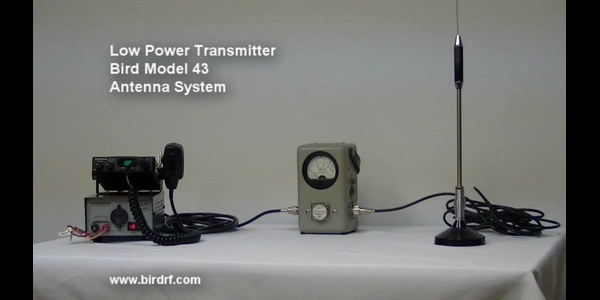
So in 1952, Bird didn't publish a paper about the problem. He built the answer and called it the Model 43 THRULINE® Wattmeter.
What Made It Different Wasn't Complexity. It Was Clarity.
The design itself wasn't complicated. A precision directional coupler paired with an analog meter movement let an engineer sample a whisper of the energy already traveling down the transmission line — forward power, reflected power — and read it directly, no backward math required. Bird patented the underlying directional wattmeter design in 1958, by which point the Model 43 had already earned a reputation for something rarer than clever engineering: it was hard to break.
Plug-in elements meant one instrument could adapt to different frequencies and power levels instead of sitting in a drawer the moment a job changed. That versatility is why it turns up in such different corners of RF history. In the 1960s it rode along in trunk-mounted mobile radio installations, boxes about the size of a microwave oven, checking the match between a transmitter and its antenna. By the 1970s, as radios shrank and cable runs stretched, it had simply moved to wherever the work was — a front seat, a service bench, a field truck — and kept telling the truth every time.
Confidence Is the Product
Here's what's easy to miss about the Model 43's story: Bird wasn't just selling a meter. He was selling certainty to engineers who'd spent years operating on assumptions.
A technician tuning an antenna match could finally see, in real time, whether the system was healthy or hemorrhaging power back at the transmitter. A broadcast engineer could prove, not estimate, that a station was compliant and performing. Public safety crews, defense programs, and two-way radio shops all built their confidence in their own systems on the back of one dependable needle.
That's the part of this story worth sitting with. Every great brand legend has a moment where it stops being a product and starts being a standard. That moment, for RF power measurement, was the Model 43.
Seventy-Plus Years. Still on the Bench.
Most inventions from 1952 are museum pieces now. The Model 43 is still in production, still strapped into service trucks and test benches around the world - more than 200,000 wattmeters and counting, in a business where most products don't survive their first decade.
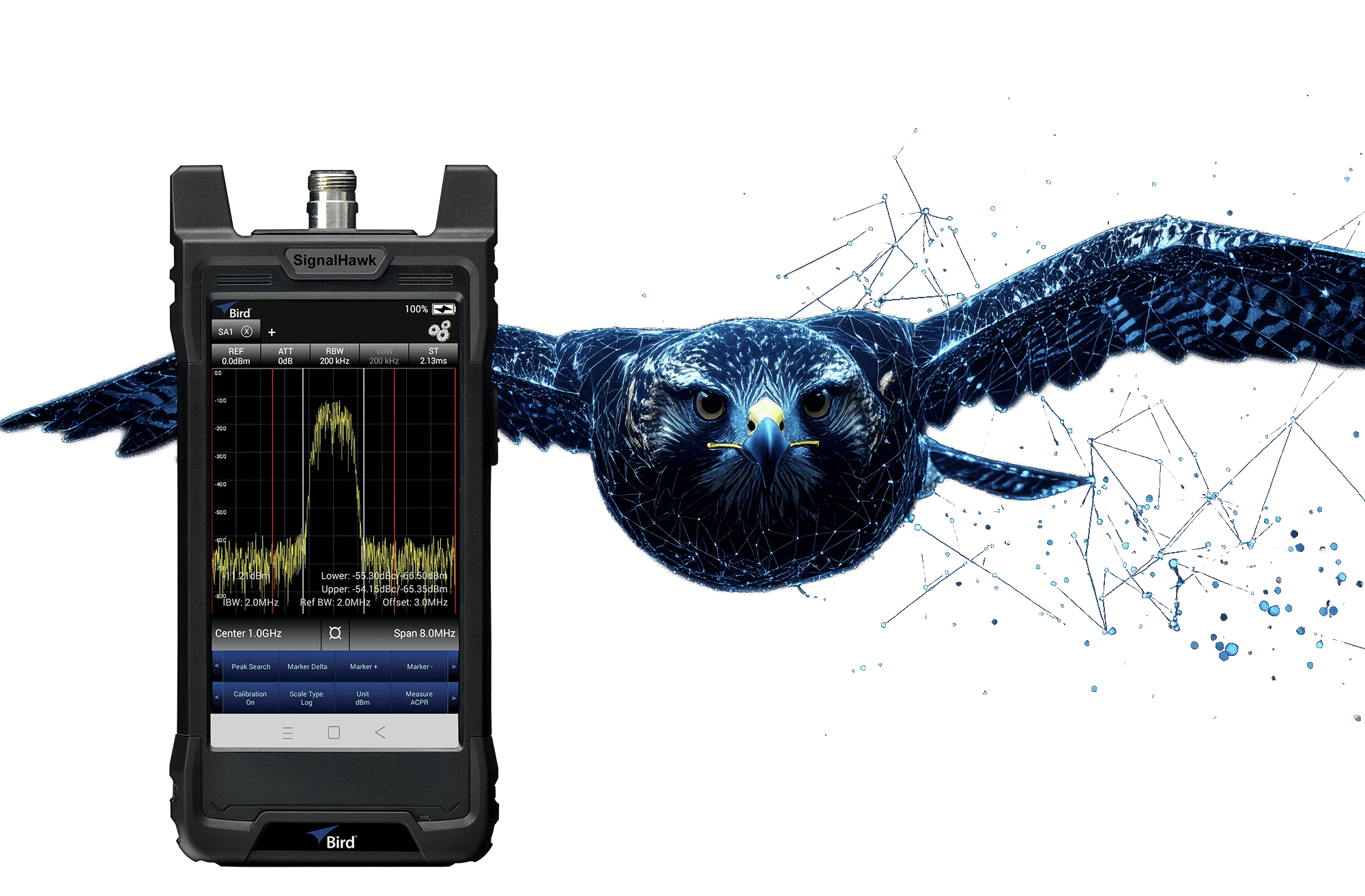
Is it the tool for every job today? No — and Bird will tell you that straight. The Model 43 measures average power on continuous-wave and analog signals; it wasn't built to make sense of the digitally modulated waveforms used in DMR, TETRA, or LTE. That work now falls to instruments like Bird's 4480A Digital Power Meter — and when Bird built it decades later to handle signals the Model 43 was never designed for, the design didn't abandon that DNA. It carried the same approach forward, this time with a microprocessor doing the math engineers once had to do themselves.
The Lesson Underneath the Legend
Every industry has a moment where guesswork stops being acceptable. Someone has to be the one who says enough and builds the thing that makes the truth visible.
For RF power measurement, that moment had a name, a year, and a model number: J. Raymond Bird, 1952, Model 43.
The needle has, in many cases, given way to a digital display. But walk into an RF shop or a broadcast facility almost anywhere in the world today, and there's a decent chance you'll still find a Model 43 doing exactly what it was built to do — telling engineers the truth about their systems, one watt at a time.
That's not nostalgia. That's what it looks like when a tool earns the right to be called a standard.
Product Comparison
The Model 43 Set the Standard. The 4480A Was Built for What Came Next.
The Bird Model 43 has earned its place in RF engineering history — trusted for decades to measure continuous wave (CW) signals with accuracy engineers could count on. But the world has changed. Today's communication systems — LTE, P25, 5G NR, APCO-25 — use digitally modulated signals that a CW-only instrument cannot accurately measure.
The 4480A was designed for exactly that world. If you work with modern digitally modulated signals and need accurate power measurement, the comparison page will help you decide which instrument belongs in your kit.
Compare the Model 43 vs. 4480A →
Katie Wright
Katie is an electrical engineer with more than 30 years of experience in RF test and measurement. She specializes in high-power RF measurement, product strategy, and technical thought leadership. During her time at Bird, she wrote about RF measurement accuracy, calibration, and the applications of high-power RF systems. She is also a licensed amateur radio operator (KD8FAD).