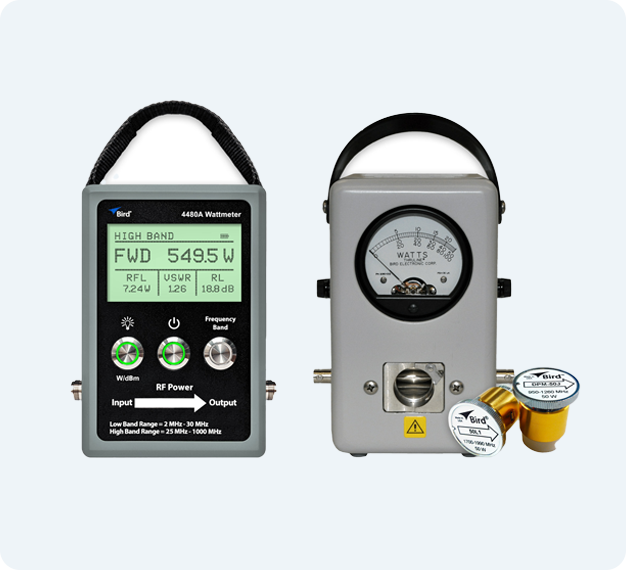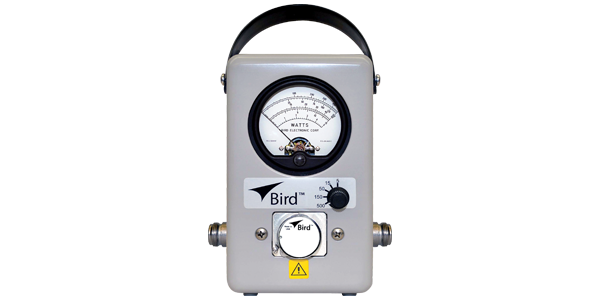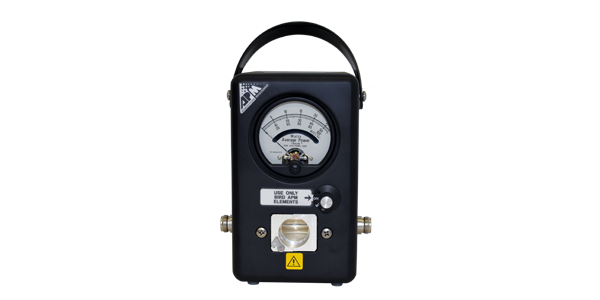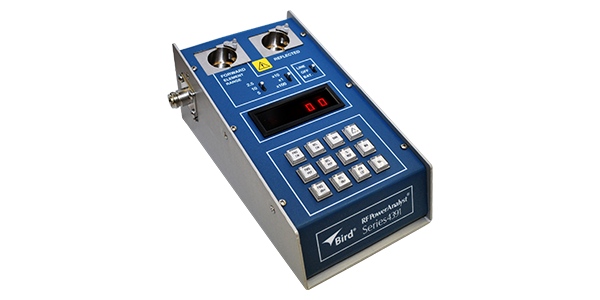
Built for dependable performance—not lab-perfect specs—Bird’s CW Wattmeters remain a trusted standard in RF testing. These analog workhorses have supported critical communications in defense, broadcasting, and land mobile radio for decades.
They offer practical accuracy for everyday power measurement—especially in high-power, analog, or stable CW systems. With swappable elements, one tool covers a wide range of frequencies and power levels.
They’re not made for digital signals or fine-tuned precision—but they’re built to last, built to travel, and built to deliver results when reliability matters most.
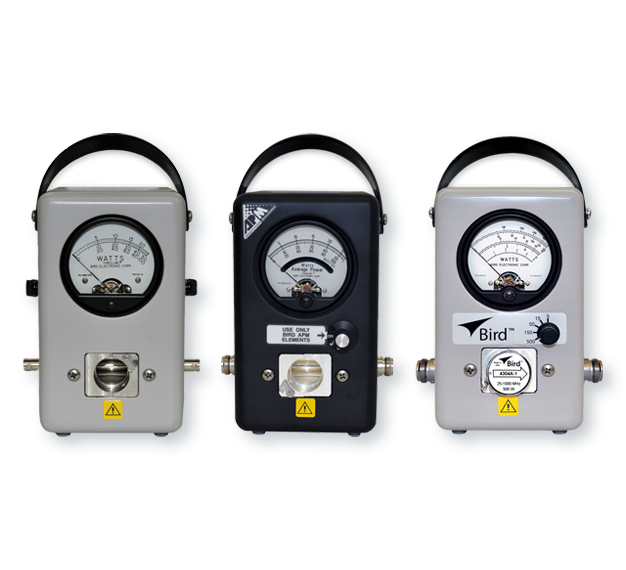
Since 1952, RF professionals have trusted Bird’s CW wattmeters to deliver reliable, repeatable results—day in and day out. Built to last and engineered for accuracy, these tools are the benchmark for analog RF measurement. When your system matters, Bird is what you reach for.
Forward and reflected power readings reveal mismatches, bad connections, and antenna faults—before they cause damage.
Fine-tune your antenna and transmitter for optimal VSWR and performance—with live, in-line power feedback.
Swap elements to match frequency and power range. Take it anywhere—from bench setups to field deployments.
Compare Bird’s CW wattmeters to find the best match for your RF power range, frequency, and field conditions.

You don’t need to be an expert to pick the right Bird CW wattmeter. Just follow these three steps to find the tool that fits your work.
Every wattmeter is designed for a specific frequency range. Make sure it covers the band you’re working in.
If you're working with AM, SSB, or pulsed signals, choose a peak power model like the 43P or 4314C.
Need to measure across multiple bands? Go with a swappable-element model like the 43. Sticking to one setup? A fixed-element model is a solid fit.
Have more questions? Get Expert Help>
A CW (continuous-wave) wattmeter measures RF power from a continuous, unmodulated RF carrier. Directional CW wattmeters are commonly used to measure forward and reflected power in transmitters and transmission systems where the carrier remains continuously present.
For example, a 100 W CW transmitter operating at 150 MHz can be measured using a wattmeter and element rated for that frequency and power level.
Technicians continue to use the Bird Model 43 because it is a rugged, field-proven instrument with a long history of reliable RF power measurement. Its simple operation and familiar measurement method make it a trusted tool for routine transmitter testing and maintenance.
For example, technicians can use the Model 43 to verify forward and reflected power during installation, preventive maintenance, or troubleshooting of an RF transmission system.
Choose a CW wattmeter element based on the operating frequency, expected power level, and compatibility with the wattmeter or line section. The element’s frequency range must include the signal frequency, and its power rating should be appropriate for the expected power level to provide a useful reading on the meter scale.
For example, measuring a 100 W transmitter at 450 MHz requires a compatible element rated for 100 W and a frequency range that includes 450 MHz.
Bird wattmeters are the standard for accurate, durable RF power measurement. From analog tools to peak power models, professionals trust Bird when it has to work—every time.
Proven Wattmeters. Trusted Results.