

How is RF Power used in MRI?
Magnetic Resonance Imaging (MRI) technology is a non-invasive way to create 3D images of soft-tissues in the body. Using a constant, strong magnetic field, hydrogen atoms are aligned inside the body. By pulsing electric fields at RF frequencies, these hydrogen atoms are excited (or moved) in ways specific to their chemical bonds before they relax back to their alignment to the magnetic field. These movements of excitation and relaxation can be measured, and the data used to create 3D images.
Why is RF Power Calibration Important?
The RF energy applied for excitation needs to be sufficient to move atoms all over the body, or part of the body, being imaged. This might require an RF amplifier to output power from 1 to 35 kW depending on the design of the MRI system, the patient, and what part of the body is being imaged. Using too little power will degrade the quality of the image. Using too much power on the other hand may harm the patient, heating the skin and causing RF burns. For both of these reasons, the "RF chains" in MRI systems need to have their output power calibrated before they are first used, and during regular maintenance throughout the life of the MRI system.
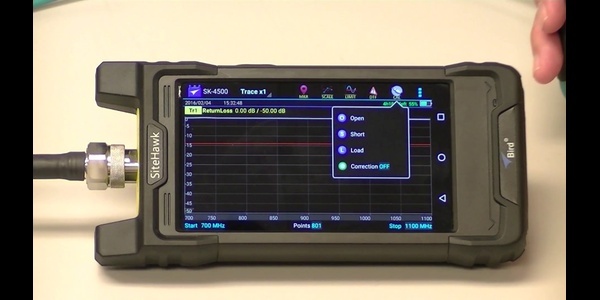
 Bird's MRI3T kit is used for calibrating the power of RF generators of many MRI systems around the world. It consists of
-
a Bird 5014 directional power sensor,
-
a 5000-NG display,
-
elements tuned and calibrated to specific frequencies used by MRIs,
-
connection adapters, and
-
a precision load to safely dissipate power during testing without radiating any RF interference.
Who Performs MRI Maintenance?
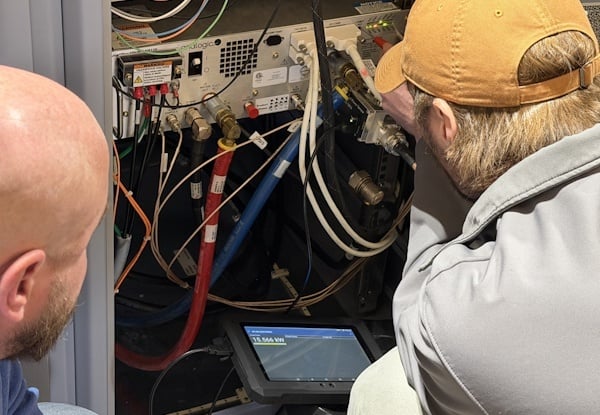
I recently visited our neighbor Radiological Service Training Institute, or RSTI, right here in Solon Ohio that provides training, service and parts for MRI systems as well as host of other radiology medical imaging technologies. As part of their hands-on courses on maintaining MRI systems, they teach students the details of the RF chain including the process of calibrating RF power.
I joined them as one of their classes completed a lab on verifying the max RF power output for a fully operational GE HealthCare Optima™ MR450w 1.5T MRI system. Using a Bird MRI3T kit, they calibrated and adjusted the body and head outputs from the RF amplifier. MRI systems typically have several different RF lines at different power levels. The frequencies used are fixed by the physics: the resonant frequencies of atoms in the particular magnetic field being used. The MRI3T kit is calibrated at unique frequencies and pulse power levels for precision in compatible systems.
Conclusion
Maintaining MRI systems is complex work and the RF chain is just a single part of these massive machines. Bird is proud to know RSTI is in our neighborhood teaching the current and next generation of service professionals with Bird precision equipment.
Contact an RF Expert at Bird
Connect with a solutions expert for knowledgeable guidance.