
How to Hunt and Locate RF Interference Using Spectrum Analysis and AOA
December 8th, 2025
5 min. read | By Brad Odhner
Topics:
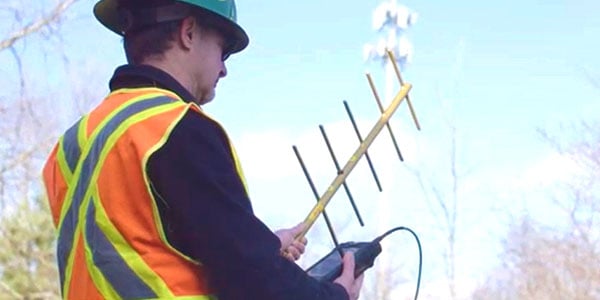
It is 2 AM and you just answered a call informing you that services on your RF communication system are being interrupted. RF interference doesn't wait for convenient business hours, and you have to respond immediately. Whether you're troubleshooting a public safety radio network, tracking down a rogue transmitter disrupting cellular service, or locating an interferer affecting aviation communications, you need results quickly. That's where the SignalHawk® Spectrum Analyzer with Angle of Arrival (AOA) becomes your essential partner in RF interference hunting.
Traditional spectrum analyzers can tell you what the interference looks like, but they leave you guessing about where it's coming from. SignalHawk changes that equation by combining professional-grade spectrum analysis with integrated direction-finding capabilities in one ruggedized, field-ready package. Let's explore why this combination makes SignalHawk the superior tool for RF interference hunting.
What is RF Interference Hunting?
Interference hunting is the systematic process of identifying, characterizing, and physically locating sources of unwanted RF signals that disrupt wireless communications. In today's congested spectrum environment, interference can originate from countless sources: malfunctioning equipment with inadequate shielding, misconfigured transmitters operating on the wrong frequencies, unauthorized devices violating regulatory standards, or even deliberate jamming attempts.
The challenge in RF interference hunting isn't just detecting the problem — it's pinpointing the exact location of the interference source so you can eliminate it. This requires specialized equipment that combines two critical capabilities: spectrum analysis to identify and characterize the interfering signal, and direction-finding technology to determine its origin.
How Do You Find the Source of RF Interference?
Finding the source of RF interference involves detecting and identifying the interfering signal, measuring its strength, and determining the direction it is coming from. Technicians first use a spectrum analyzer to identify the interfering frequency and characterize the signal. They then trace the signal using a directional antenna or direction-finding technology, such as Angle of Arrival (AOA), while moving through the coverage area. By collecting measurements from multiple locations, they can triangulate the interference source, pinpoint its location, and eliminate the problem.
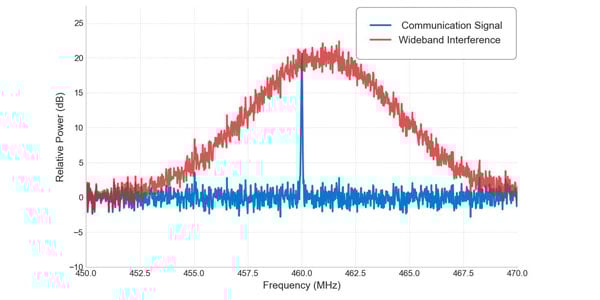
Detecting interference begins with spectrum analysis — visualizing the radio frequency environment to identify unwanted signals. SignalHawk excels at this fundamental task with its wide frequency coverage from 9 kHz to 6 GHz (Model SH-60S-AOA) or 7.5 GHz (Model SH-75S-AOA), ensuring you can monitor virtually any commercial wireless system.
What sets SignalHawk apart for interference hunting is its simplified operation. Unlike complex spectrum analyzers that require extensive RF expertise, SignalHawk's predefined measurement functions eliminate the need for manual configuration of complex parameters. The instrument automatically adjusts attenuation, resolution bandwidth, and sweep time to provide an optimal spectrum view, meaning even technicians with limited RF experience can quickly identify interference.
The high-brightness, sunlight-readable 5.5-inch display shows clear spectrum traces and spectrograms, making it easy to spot interfering signals even in challenging outdoor environments. With a display average noise level of -169 dBm/Hz (typical, with 40 dB preamplifier), SignalHawk can detect even weak interference that might escape notice with less sensitive equipment.
How Do You Eliminate Signal Interference?
Eliminating signal interference requires more than detection. You must physically locate and eliminate the source. This is where SignalHawk's integrated angle of arrival capability transforms interference hunting from a frustrating guessing game into a systematic, efficient process.
Here's how RF interference hunting simplifies the interference hunting process:
Finding the source of RF interference is a systematic process. Technicians first identify and characterize the interfering signal with a spectrum analyzer. Next, they collect direction measurements from multiple locations using a directional antenna or Angle of Arrival (AOA) technology. Comparing those measurements allows the interference source to be accurately located and eliminated.
Step 1: Characterize the Signal — First, use SignalHawk's spectrum analysis to identify the interference frequency, measure its power level, and document its characteristics. Screen captures and predefined measurements like Channel Power and Occupied Bandwidth provide the documentation you need.
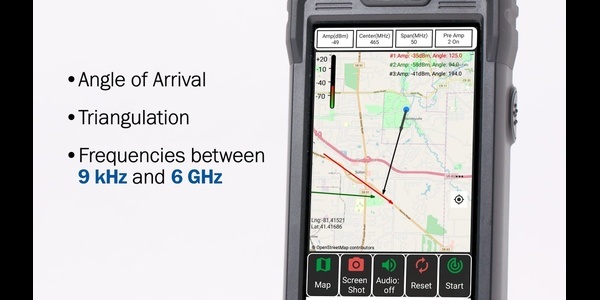
Step 2: Take AOA Measurements — Connect a directional antenna and move to your first measurement location. Activate SignalHawk's AOA mode and rotate 360 degrees while the instrument tracks signal strength versus bearing angle using its integrated GPS and digital compass. SignalHawk automatically plots a bearing line on its downloaded street map showing the direction of the strongest signal.
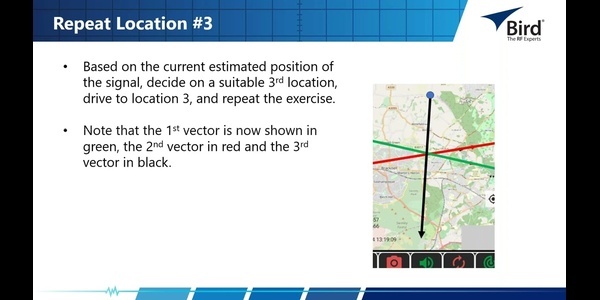
Step 3: Triangulate the Source — Travel to two or three additional locations (ideally 80-100 degrees apart) and repeat the AOA measurement. SignalHawk displays all bearing lines on the map in real time, with their intersection pinpointing the interference source location, typically within 50-100 meters in urban environments.
Step 4: Eliminate the interference — Once located, the interference can be shut down, repaired, or reported to regulatory authorities.
For more information on interference hunting and best practices for angle of arrival measurements, see the white paper, Easily Perform Spectrum Analysis and Interference Hunting in the Field.
Built for the Field, Not the Lab
Many interference hunting scenarios require working in challenging environments such as outdoor sites, remote locations, industrial facilities, or rooftops. SignalHawk is designed for these real-world conditions.
At just 1.98 pounds and measuring only 7.8 x 3.7 x 2.4 inches, SignalHawk is barely larger than a smartphone. This lightweight, portable design means you can carry the analyzer in one hand while maneuvering a directional antenna with the other, avoiding awkward equipment juggling or fatigue during extended interference hunting sessions.
The rugged, sealed enclosure protects against dust, moisture, and physical impacts. Operating across temperatures from 0 °C to 50 °C, SignalHawk handles the environmental extremes that field technicians face daily. Whether you're tracking interference on a sweltering summer afternoon or investigating communication problems on a cold winter night, SignalHawk keeps working.
The 5-hour battery life ensures you can complete RF interference hunting missions, including multiple site visits for triangulation, without interruption. There is no need to search for power outlets or carry backup batteries into the field.
Speed When Every Minute Matters
In interference hunting, time is critical. Public safety agencies can't wait hours or days for communications to be restored. Cellular carriers lose revenue with every minute of degraded service. SignalHawk accelerates the entire workflow from detection to location.
The GPS and mapping integration eliminates manual recording of coordinates and bearing angles, potential sources of error that slow traditional direction-finding. SignalHawk automatically captures position, bearing, signal strength, and timestamp for each measurement, plotting results on street maps in real time. You see the probable source location converge as you take measurements, enabling intelligent decisions about where to measure next.
The multi-touch interface and intuitive menus reduce setup time. Predefined measurement functions mean you're analyzing interference easily and quickly. Faster measurements mean faster resolutions, and that matters when critical communications are down.
What Equipment Do You Need for RF Interference Hunting?
Successful RF interference hunting requires more than a basic spectrum analyzer. Most technicians use a combination of spectrum analysis, a directional antenna, GPS mapping, and direction-finding technology to identify and locate interference sources. Integrating these capabilities into a single instrument simplifies field work, reduces setup time, and speeds troubleshooting.
SignalHawk delivers laboratory-quality measurements in its compact, field-ready form factor. The -169 dBm/Hz typical noise floor (with preamplifier) provides the sensitivity needed to detect weak interference. Wide dynamic range handles everything from barely detectable signals to high-power transmitters. Resolution bandwidth options from 10 Hz to 5 MHz enable detailed signal characterization.
Predefined measurements, including Channel Power, Adjacent Channel Power Ratio, Occupied Bandwidth, and Phase Noise, provide the analysis depth needed for thorough interference characterization and regulatory documentation.
View all the SignalHawk models and options on Bird’s Spectrum Analyzers webpage.
The Bottom Line for RF Interference Hunting
When RF interference threatens critical communications, you need equipment that identifies the problem quickly and locates the source accurately. SignalHawk's integration of professional spectrum analysis with Angle of Arrival direction-finding delivers both capabilities in one ruggedized, field-ready package that technicians can deploy easily.
The combination of simplified operation, lightweight portability, GPS/mapping integration, rugged construction, and long battery life makes SignalHawk the optimal tool for interference hunting across diverse applications, from public safety communications to cellular networks, broadcasting, aviation systems, and industrial facilities.
Don't let RF interference keep your systems down. With SignalHawk, you have the power to detect, locate, and eliminate interference sources efficiently, turning communication crises into manageable problems with same-day solutions.
Visit the SignalHawk AOA page to learn more about how SignalHawk can enhance your interference hunting capabilities.
Brad Odhner is a former Product Manager at Bird, where he specialized in spectrum analyzers, cable and antenna analyzers, signal generators, and vector network analyzers. He has a degree in Physics from Case Western Reserve University and contributed technical content on RF measurement, test, and analysis.
Explore Posts by Topic:
Products Featured:
Contact an RF Expert at Bird
Connect with a solutions expert for knowledgeable guidance.