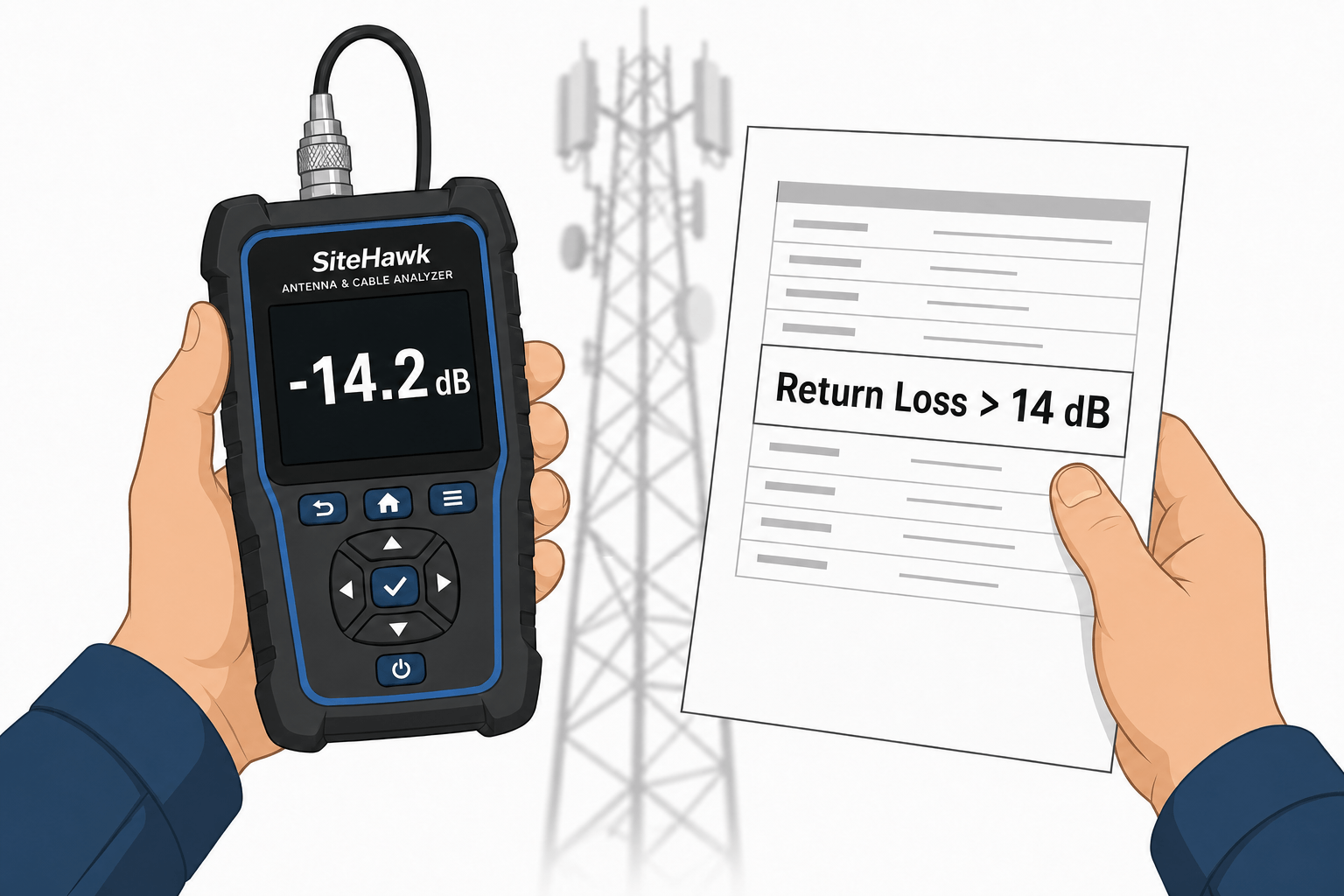
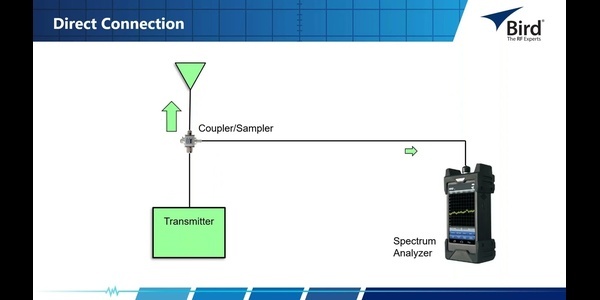
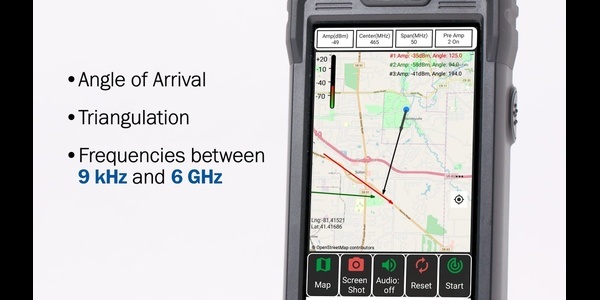
A field tech is standing at the base of a tower with a spec sheet in one hand and an analyzer in the other. The spec says "return loss must be better than 14 dB." The analyzer says "−14.2 dB."
He stares at the negative sign like it's a warning light.
Fourteen is bigger than negative fourteen point two, right? So does that mean he passed, or failed? He's got a truck idling, a customer waiting on a report, and a decision to make. He makes the call. Sometimes he's right. Sometimes he isn't. The problem isn't the measurement, it's that the instrument and the specification may not be speaking the same language.
That moment happens on towers, in labs, and in QA meetings every single day. Not because the engineers involved are careless. Because return loss has been living a double life since before most of them were born — and nobody ever sat them down and explained the split.
Two Rooms, Two Languages
Picture RF engineering as a building with two wings, built decades apart, that never quite got their blueprints to match.
In the first wing — the classical wing, the one full of antenna textbooks and cable spec sheets — engineers talk about loss the way everyone talks about loss. Cable loss is a positive number. Insertion loss is a positive number. So when they measure how much power didn't come back at them, they call that a loss too, and they write it down as positive. Bigger number, better match. A return loss of 20 dB beats a return loss of 10 dB, the same way a 20-year warranty beats a 10-year warranty. Nothing counterintuitive about it. That's the IEEE convention, and it's the language most antenna and cable specifications are still written in.
Walk down the hall to the second wing, and the vocabulary changes entirely. This wing runs on S-parameters — the language of network analyzers. Here, nobody talks about "loss." They talk about S11, the ratio of the voltage that came back to the voltage that went out. Since a decent match always sends back less than it received, that ratio is always less than one, and in decibels, less than one is always negative. A perfect match isn't infinitely good here — it's negative infinity. A dead short, reflecting everything, sits at zero.
Both wings describe the exact same reflection. Neither one is wrong.
Where the Trouble Starts
The trouble isn't the math. It's that the building never posted a sign telling you which wing you just walked into.
Your network analyzer displays S11. Negative, always, no debate. But pick up a cable and antenna analyzer, and the convention depends entirely on who built it — and sometimes on what firmware it's running. A Bird SiteHawk, for instance, displays return loss as a negative number — consistent with how most field instruments in the communications environment actually report it. Another manufacturer's analyzer, measuring the identical connector on the identical cable, might hand you a positive one instead. Same signal. Same match. Opposite sign.
Now put that spec sheet back in the tech's hand. "Return loss better than 14 dB" and "return loss better than −14 dB" are not competing standards. They are the same requirement, translated into two dialects. The relationship is simple:
Return loss (dB) = −S11 (dB)
Flip the sign, and you've crossed the hallway. That's the entire translation. Here’s what that looks like in the field:
|
Specification
|
Instrument Reading
|
Result
|
|
Better than 14 dB
|
−16.8 dB
|
✅ Pass
|
|
Better than 14 dB
|
−13.2 dB
|
❌ Fail
|
An engineer who was trained reading a network analyzer will instinctively think in negative numbers. Hand him a positive spec, and some part of his brain will read it backwards — because he's not doing math, he's pattern-matching against years of muscle memory. That's how a perfectly healthy site gets flagged as a failure, and how a marginal one slips through as a pass. Not from ignorance. From two correct conventions colliding without a translator in the room.
The Rule That Ends the Argument
So the tower tech, engine still running, doesn't need a lecture on wave theory. He needs one rule, and it fits on an index card:
Before you compare a return loss number to a threshold, find out which convention wrote that threshold.
If the instrument in your hand and the spec in your other hand don't agree on sign, one of them is speaking the S11 dialect and the other is speaking classical loss — and until you know which is which, the number in front of you means nothing at all.
Bird's documentation, including the SiteHawk, uses the negative convention throughout, matching how most field instruments in a communications environment actually display the reading. If you're cross-referencing a spec from another manufacturer or an older textbook, don't assume it shares that convention. Confirm it. It takes ten seconds, and it's the difference between a report you can stand behind and a coin flip with your name on it.
Nobody designed this confusion on purpose — two conventions just grew up in different rooms and never met. Once you know which convention your instrument and your specification use, return loss becomes exactly what it should be: an unambiguous measurement.
Go deeper with your RF power measurement education and check out the RF Fundamentals: The Engineer's Reference.
Katie Wright
Katie is an electrical engineer with more than 30 years of experience in RF test and measurement. She specializes in high-power RF measurement, product strategy, and technical thought leadership. During her time at Bird, she wrote about RF measurement accuracy, calibration, and the applications of high-power RF systems. She is also a licensed amateur radio operator (KD8FAD).