
Common RF Interference Problems & How Spectrum Analyzers Find Them
January 23rd, 2026
4 min. read | By Brad Odhner
Topics:
We hear from many customers that RF (radio frequency) interference is no longer an occasional nuisance—it’s increasingly an everyday operational challenge. From public safety communications to cellular networks and industrial systems, unwanted RF signals can degrade performance, reduce reliability, and in critical cases, put lives and operations at risk. Understanding where interference comes from and how to find it quickly is essential.
This is where a modern RF spectrum analyzer becomes indispensable. Even more powerful is a spectrum analyzer that not only detects interference, but also helps you locate its source. Bird’s SignalHawk® Spectrum Analyzer with Angle of Arrival (AOA) was designed specifically to meet this challenge.
Common Sources of RF Signal Interference
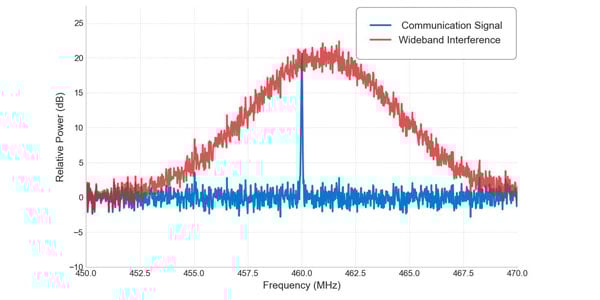
RF interference generally falls into a few well-known categories, all of which can disrupt RF infrastructure by raising the noise floor, masking desired signals, or even overpowering wanted signals.
Unintentional Radiators
Many electronic devices emit RF energy unintentionally due to poor shielding or faulty design. Power supplies, industrial equipment, LED lighting, and consumer electronics can all leak RF energy at unpredictable frequencies, causing intermittent, difficult-to-diagnose interference.
Misconfigured or Faulty Transmitters
Transmitters operating on the wrong frequency, with excessive output power, or with degraded components can spill energy into adjacent channels. Adjacent-channel interference is a common cause of dropped calls and degraded throughput in wireless networks.
New installations can be particularly troubling. In one case, we helped a county public safety office resolve radio issues around a new construction site. The issue was localized to a particular building, and after working with the owner, the problem was determined to be the Distributed Antenna System (DAS) bidirectional amplifiers in the building. The contractor configured the amplifiers incorrectly; their outputs were too strong and interfered with the public safety radios.
Non-Compliant or Unauthorized Devices
Unlicensed transmitters, malfunctioning repeaters, or improperly installed radios may violate regulatory limits. These signals often appear unexpectedly and can be difficult to trace without proper tools.
Deliberate Signal Interference and Jamming
Although less common, deliberate interference — such as signal jammers — can cripple communications. These signals are often intermittent or mobile, making rapid detection and location critical.
Intermodulation and Multipath Effects
When multiple strong signals interact in non-linear devices, intermodulation products are created at new frequencies. In dense RF environments, reflections from buildings and terrain can further complicate the interference picture.
Why RF Interference Is Such a Problem
RF Interference impacts more than just signal quality. It can reduce receiver sensitivity, lower data rates, and cause complete communication failures. For public safety and mission-critical systems, the cost of delayed resolution is high — lost productivity, regulatory exposure, and increased safety risks. Detecting interference is only half the battle; finding the source is what ultimately solves the problem.
How Spectrum Analyzers Detect Interference
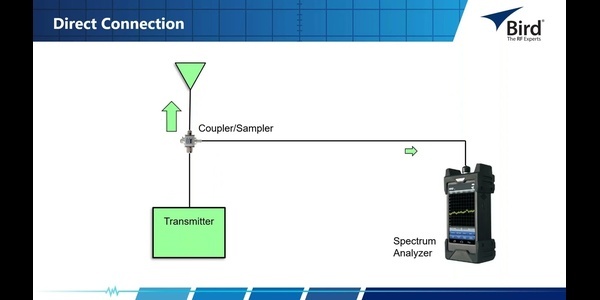
An RF spectrum analyzer visualizes signal energy across frequency, enabling quick identification of unwanted signals. With a handheld spectrum analyzer like SignalHawk, technicians can:
- Identify unexpected signals by frequency and power level
- Measure bandwidth, modulation, and spectral masks
- Use spectrogram (waterfall) displays to observe intermittent or time-varying interference
- Document interference with captured traces and data
This capability allows users to confirm that interference is present and understand its impact on their system.
Taking the Next Step: Locating Interference with AOA
Traditional spectrum analyzers stop at detection and identification. To locate a source of interference, you must use techniques like Time of Arrival (TOA) or Angle of Arrival (AOA). Both techniques are methods for locating the source of RF signals. AOA is generally more portable and faster to deploy, while TOA is often better suited to permanent installations that require heightened security.
How SignalHawk with AOA Works
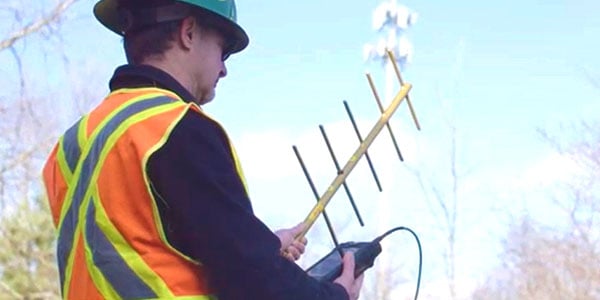
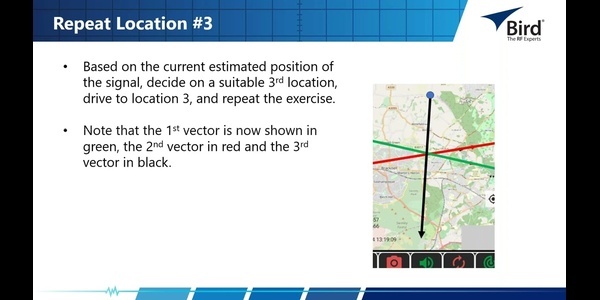
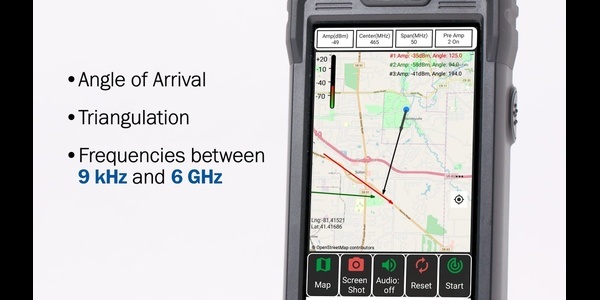
After identifying an interfering signal using spectrum analysis, technicians can follow an interference-hunting workflow to locate its source. With a directional antenna, SignalHawk measures the direction of the strongest signal from a single location. A built-in GPS and an internal compass automatically record your position and bearing. In addition, a digital map display presents a vector indicating the direction of the captured signal.
By taking measurements from three or more locations, SignalHawk triangulates the source of interference. In many environments, this process narrows the source to a specific building or area — often within tens of meters.
Designed for Ease of Use
SignalHawk with AOA is designed to be usable by anyone, not just RF experts. It includes features to simplify spectrum hunting:
- Integrated spectrum analysis and AOA in one device
- Automatic GPS and compass angle capture during AOA
- Offline map support for remote locations
- Intuitive touchscreen interface with predefined measurements
- Handheld form factor and an all-day battery life
The result is faster resolution with fewer site visits and less guesswork.
The Benefits of SignalHawk with AOA
Using SignalHawk with AOA transforms interference hunting from a complex, time-consuming task into a straightforward workflow. A single spectrum analyzer can detect, analyze, and locate RF interference in the field quickly and accurately. Its rugged, lightweight design and long battery life make it ideal for real-world conditions, while its ease of operation reduces training time and accelerates results.
Solve RF Interference Faster
As spectrum congestion continues to increase, RF interference will remain a persistent challenge. Having the right RF spectrum analyzer makes all the difference. With integrated Angle of Arrival capability, Bird’s SignalHawk gives professionals the ability to not only see interference, but to find it, fix it, and restore reliable communications with confidence.
Learn more about how the SignalHawk with AOA can help you easily overcome RF interference challenges.
Frequently Asked Questions About RF Interference
What causes radio frequency interference?
RF interference can be caused by other transmitters, faulty equipment, harmonics, intermodulation products, electrical devices, poor shielding, or signals operating near the desired frequency. Interference may be continuous, intermittent, or occur only when another device or transmitter is active. For example, a receiver operating at 450 MHz may experience interference from a strong adjacent-channel signal at 450.025 MHz if the receiver does not adequately reject that signal.
How can you tell if interference is affecting your signal?
RF interference may cause increased noise, dropped communications, distorted audio, receiver desensitization, or intermittent system performance. A spectrum analyzer can reveal unexpected signals or changes in the noise floor, especially when measurements are compared before, during, and after the problem occurs. For example, if the measured noise floor rises from –100 dBm to –80 dBm whenever a nearby transmitter becomes active, that change may indicate the transmitter is contributing to the interference.
How do you fix RF interference once you find it?
Fixing RF interference starts with confirming the source, frequency, and effect on the affected system. Depending on the cause, corrective action may include repairing faulty equipment, improving shielding or grounding, adding appropriate filtering, increasing separation between equipment, or correcting the source of the unwanted signal. For example, if testing shows that a nearby transmitter is producing an unwanted harmonic, repairing or filtering that transmitter may eliminate the interference at the affected receiver.
Brad Odhner is a former Product Manager at Bird, where he specialized in spectrum analyzers, cable and antenna analyzers, signal generators, and vector network analyzers. He has a degree in Physics from Case Western Reserve University and contributed technical content on RF measurement, test, and analysis.
Explore Posts by Topic:
Products Featured:
Contact an RF Expert at Bird
Connect with a solutions expert for knowledgeable guidance.