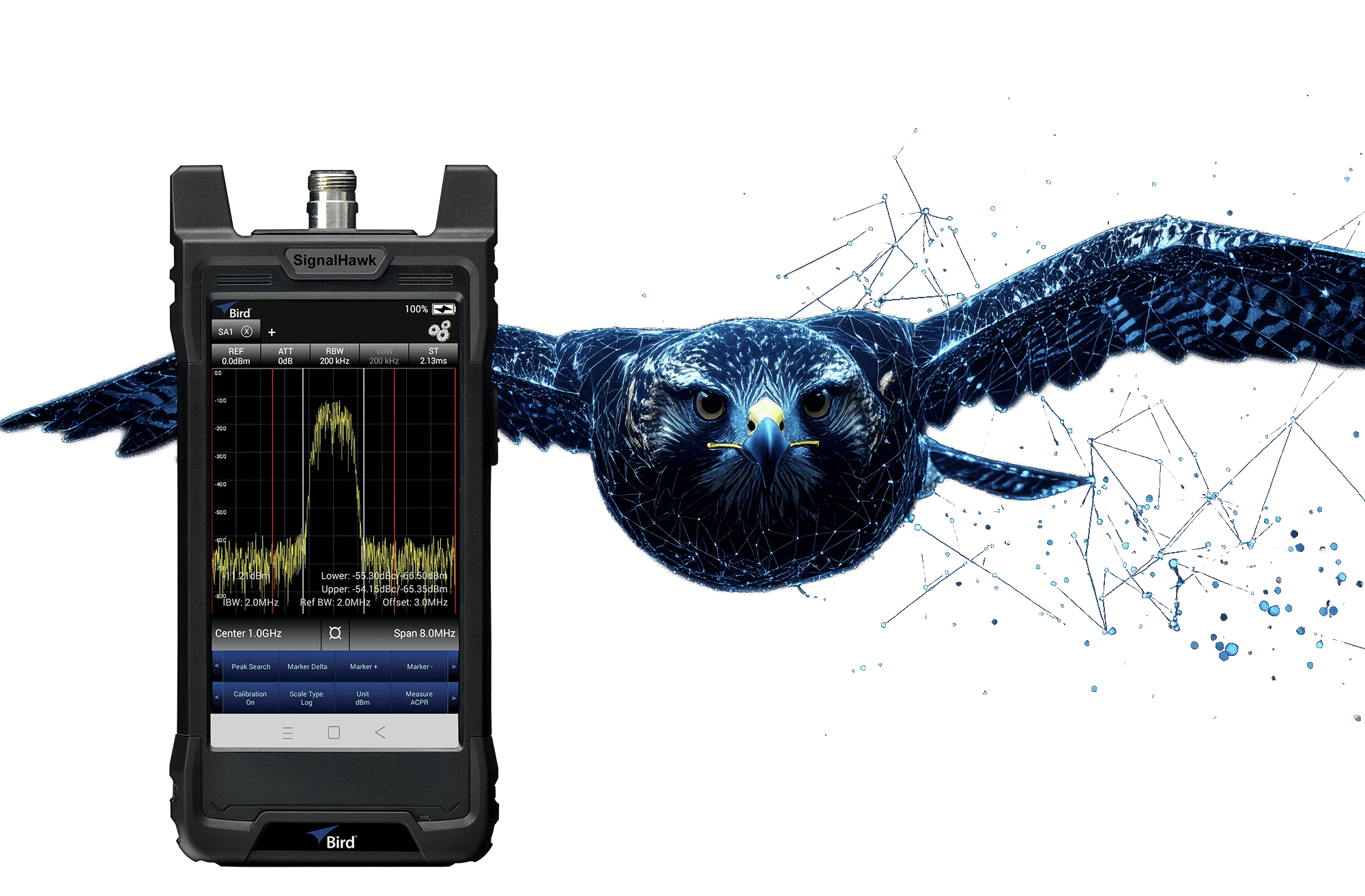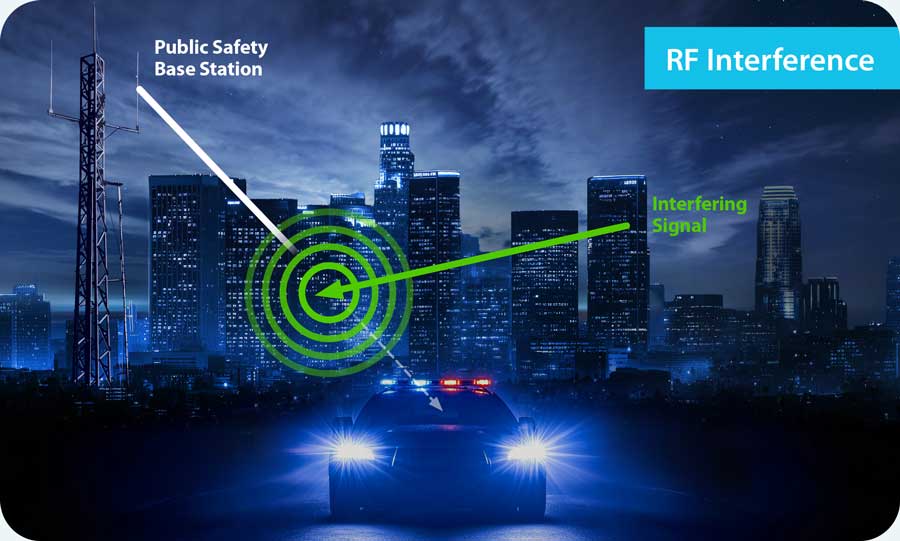
Radio Frequency (RF) interference disrupts critical communications across commercial, military, and public safety networks. SignalHawk AOA doesn't just detect interference — it pinpoints exact locations using integrated GPS mapping and automatic triangulation. This lightweight, field-portable solution, with a simplified user interface designed for RF technicians, combines professional spectrum analysis with precise interference location in a mobile phone-sized handheld package.
As wireless spectrum becomes increasingly congested, RF interference threatens mission-critical communications across every sector. Common culprits include faulty electronic devices, misconfigured equipment, non-compliant devices, intentional jammers, and malfunctioning distributed antenna systems.
Traditional interference-hunting methods fall short. Heavy laboratory equipment is challenging to transport and operate in the field. Extended service outages lead to customer dissatisfaction, regulatory compliance issues, and safety risks in emergency communications. Field technicians need a faster, simpler solution.

SignalHawk combines spectrum analysis with integrated angle-of-arrival technology in a handheld package — delivering professional interference-location capabilities without the weight, complexity, or cost of alternative solutions.

1.98 lbs (0.9 kg) — 3X lighter than competitive products
7.8" × 3.7" × 2.4" (197 mm x 93 mm x 61 mm)
Light enough for drone integration
supports full-shift operation
0°C to 50°C
for outdoor environments
5.5-inch touchscreen readable in direct sunlight

The SignalHawk model SH-60S-AOA covers the frequency range 9 kHz to 6 GHz, and the model SH-75S-AOA extends coverage out to 7.5 GHz. These models enable testing in commercial cellular, military, and public safety frequency bands.
Laboratory-grade Displayed Average Noise Level of -168 dBm/Hz, typical, with the preamp +40 dB preamp
Sweep speed: More than 2× faster than competitors
Two-level internal preamplifier for weak signal detection
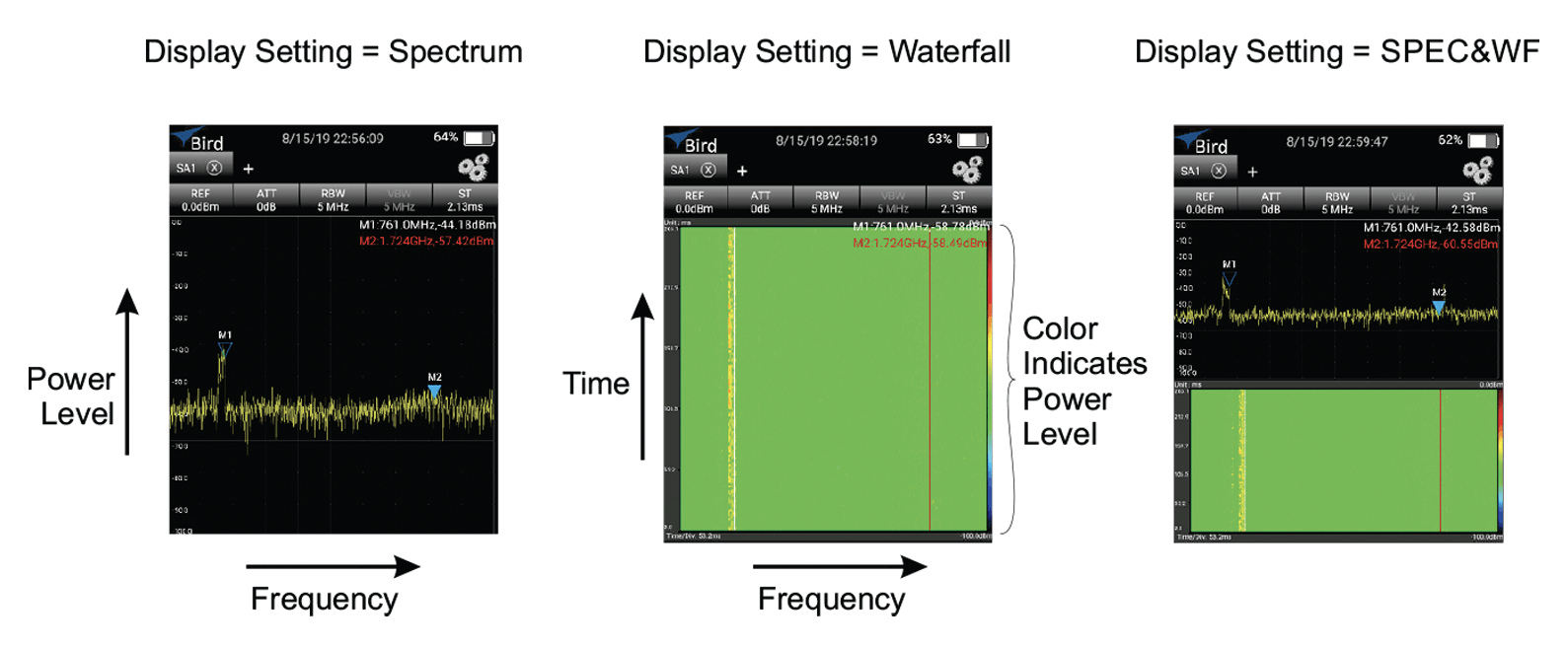
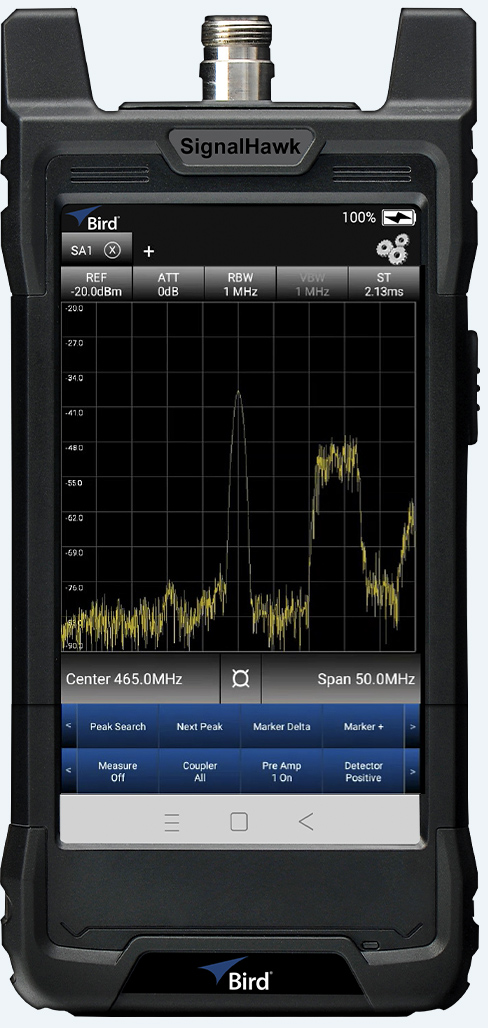
Display with multiple display formats and multi-touch pinch and zoom operation
N dB Bandwidth
Field Strength
FM Demodulation
CNR Loss (GNSS Signal Quality)
Spectrum Masking
Gate Scanning (SH-75S-AOA)
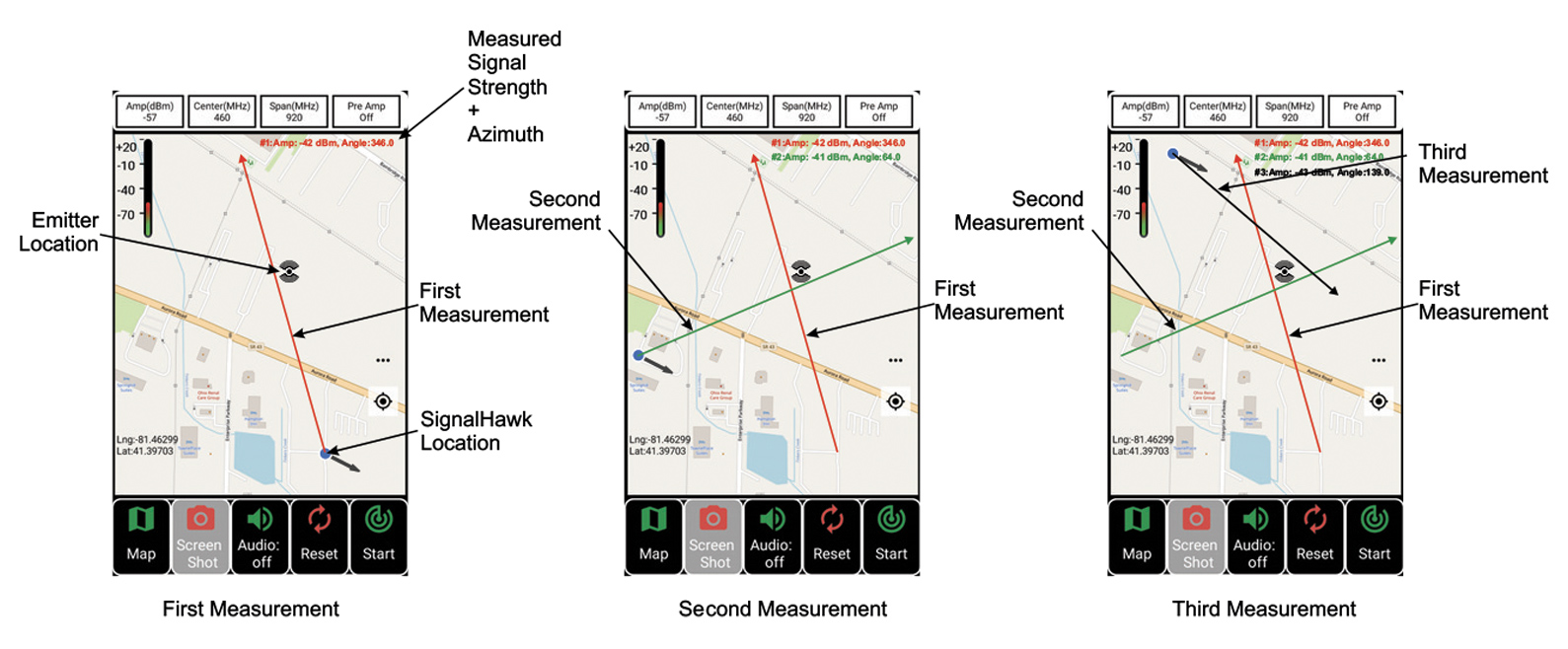
Once the spectrum analyzer has identified an interfering signal, the technician performs the following operations at three or more locations:
GPS lock and map download
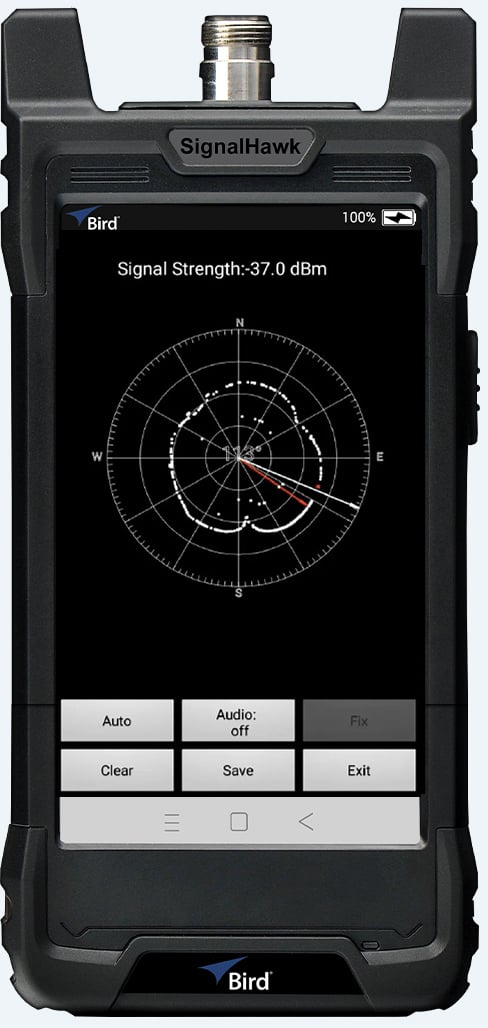
Rotate SignalHawk with a directional antenna in a 360° circle to map the signal strength of the interfering signal.
Automatic triangulation displays the intersection point
Interfering signal identified

Locating the direction of the strongest signal at a site
SignalHawk has all the additional features required for precise angle of arrival location identification:
Built-in GPS receiver
Automatic location tracking
Integrated electronic compass
Real-time map overlay with vectors
OpenStreetMap integration
Audio guidance for pinpointing the direction of the interfering signal


Angle of Arrival measures the direction from which an RF signal is received. A directional antenna rotates to find maximum signal strength. The direction of the peak signal indicates the bearing to the interference source. Signal strength and GPS coordinates are recorded at each measurement point.
Three or more measurement points with different bearings create lines that intersect around the interference source. This provides precise location coordinates, visual map confirmation, and a documented measurement trail — eliminating guesswork in location determination.
50-100 meters
20-30 meters
5G network deployment, drive testing, minor cell troubleshooting, PIM source location, and unauthorized transmitter detection.
First responder frequency protection, emergency network reliability, DAS inspection, and malicious jamming detection.
Spectrum monitoring, electronic warfare, communication network protection, GPS spoofing detection, and rapid deployment scenarios.
SCADA system interference resolution, smart grid RF reliability, remote site troubleshooting, and maintenance verification.
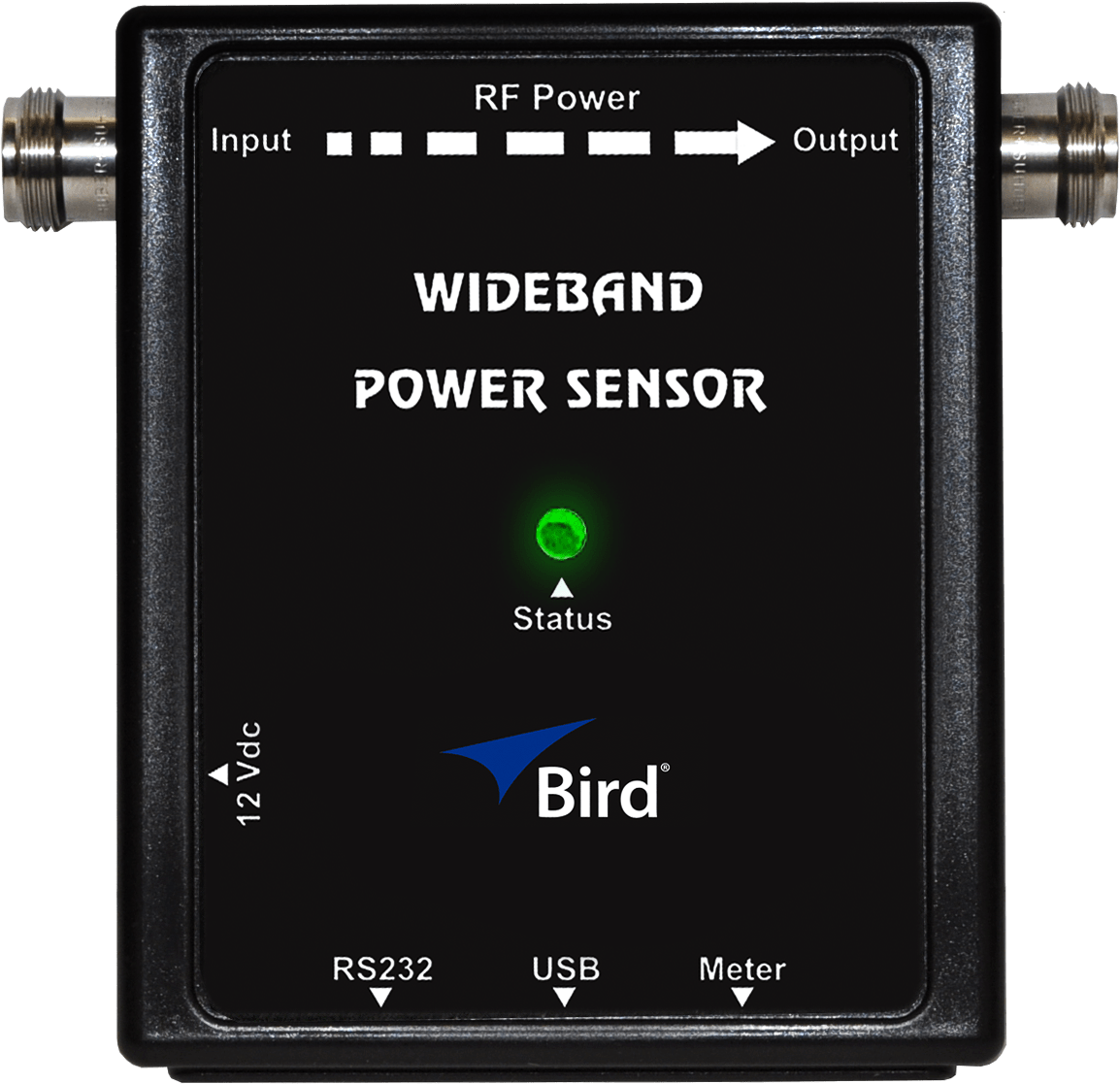
SignalHawk's built-in RF Meter App enables high-accuracy RF power measurements when paired with Bird's industry-leading wideband RF power sensors. Compatible sensors cover 25 MHz to 6 GHz with a peak power range of up to 1300 W or 500 W average.
Use SignalHawk to locate interference, then switch to power meter mode with a Bird sensor to quantify transmitter output power — all without changing instruments.

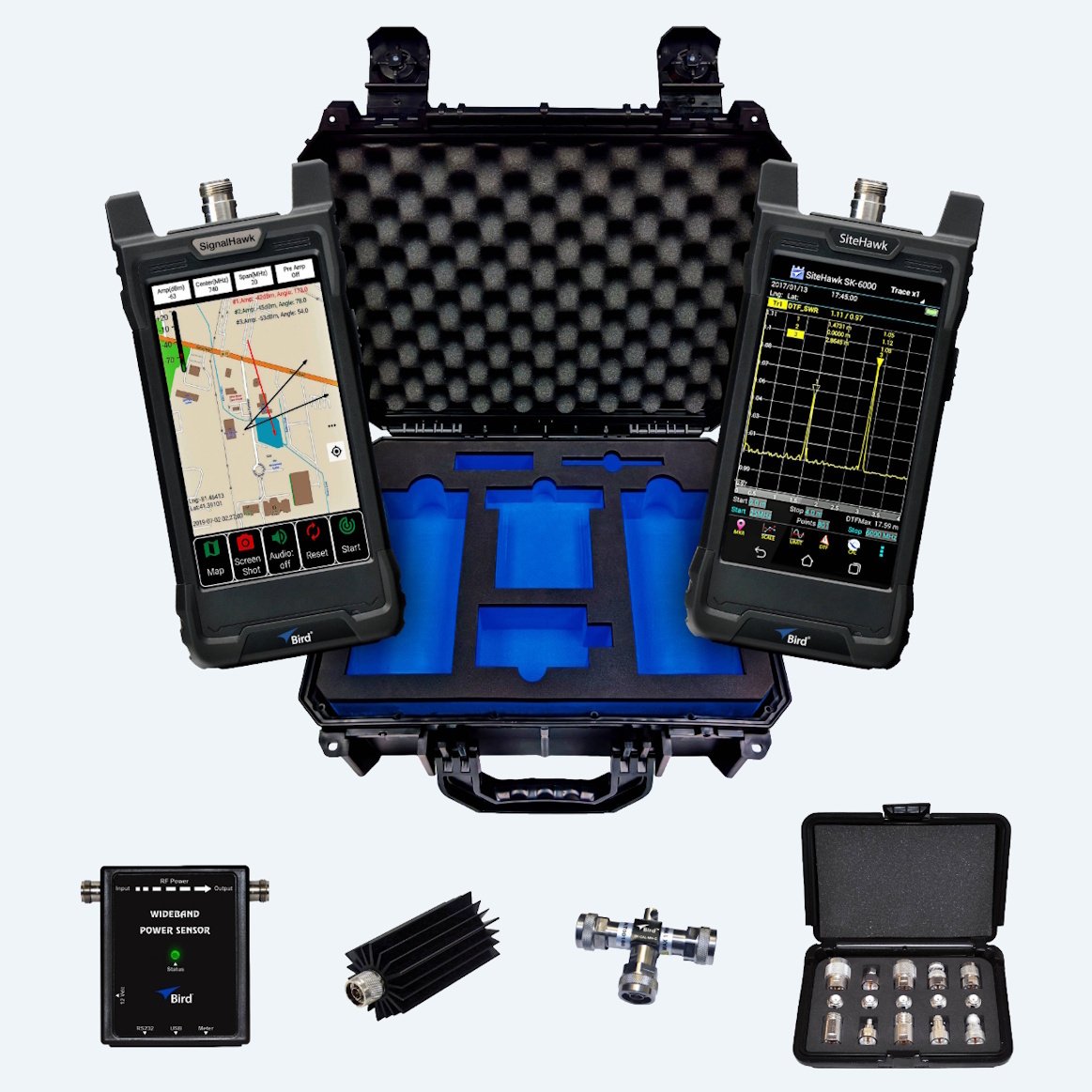
Bird offers pre-configured Master Analyzer Kits bundling SignalHawk AOA with essential accessories for complete field testing: SiteHawk Cable and Antenna Analyzer, RF power sensor, load, hard carrying case, adapter kit, and all supplied instrument accessories.
Custom configurations are available. Bird's RF experts can design a kit tailored to your testing and interference-hunting requirements.
See the RF Analyzer Test Kits.
Ready to eliminate RF interference faster? Learn more about SiteHawk with Angle of Arrival.
Have more questions? Get Expert Help
RF interference can be caused by many sources, including transmitters operating at incorrect frequencies or with excessive power, unintended emissions from electronic devices leaking RF energy due to poor shielding, multipath reflections from metal structures, and jamming devices. These sources generate unwanted signals at or near the frequencies used by your system, raising the noise floor and degrading performance.
Eliminating RF interference requires a combination of shielding sensitive equipment with metal enclosures, installing filtering circuits to suppress unwanted signals, and proper grounding techniques. Additionally, switching to a different frequency or channel can provide immediate relief from interference. Using RF spectrum-monitoring tools and analyzers helps identify interference sources, enabling targeted mitigation and ensuring optimal system performance.
Typical symptoms of wireless RF interference include dropped calls, degraded communication quality with noisy or interrupted signals, and slower internet speeds. Slower internet speeds can result in frozen video streams, long data transmission delays, and intermittent audio during video calls or streaming.
Direction of Arrival (DoA) is the generic name of techniques in signal processing used to determine the direction of a signal's source relative to a point. DoA is used in a variety of applications, including radar, sonar, wireless communication, and interference hunting.
Angle of Arrival (AoA) is a specific technique for performing DoA where a single sensor is rotated to determine the direction of a signal source. Multiple measurements at different locations, combined with geolocation signals and mapping software, can determine the area from which the RF signal originates. Due to multipath propagation and line-of-sight challenges, at least three measurements are required to triangulate the location of the signal. More measurements can more precisely narrow the area of uncertainty.
Another method to accomplish DoA is to use the time delay between signals received at different sensors in an array to determine the angle of arrival of the signal. This method is called Time of Arrival or Time Difference of Arrival (TDoA) and still requires multiple measurements and different points to turn a direction into an area where the signal source could be. The SignalHawk is not capable of performing TDoA.
A spectrum analyzer and a signal analyzer are both electronic test instruments used in telecommunications. While both instruments have overlapping functionality, their main difference lies in their focus. Spectrum analyzers prioritize frequency-domain analysis, while signal analyzers include time-domain analysis as well.
Spectrum analyzers measure the power magnitude vs. frequency of signals, such as RF signals. Signal analyzers perform magnitude and phase measurements vs. frequency, as well as time-domain analysis. While enhanced function spectrum analyzers can perform some demodulation analysis, signal analyzers perform more in-depth analysis, such as error vector magnitude measurements, code domain power analysis, and spectral flatness.
Some spectrum analyzers perform angle-of-arrival measurements to locate the position of a signal source, such as an interfering source. Signal analyzers do not perform this function.