
Ensuring precision plasma power for advanced node device manufacturing
RF power creates and sustains the plasma in semiconductor plasma processing tools. A plasma is an ionized gas, a collection of ions, electrons, and neutral species that become chemically and physically active when energized by RF power. In plasma etching, plasma removes material from a wafer surface. In plasma-enhanced deposition, it drives the chemical reactions that form thin-film layers on the wafer.
For advanced semiconductor manufacturing, accurate control of RF power is a primary determinant of successful wafer production. RF power variations exceeding the allowable limits specified in a fabrication recipe directly impact plasma energy density and its performance. Too much or too little power shifts etch depth or alters deposition layer thickness. Both conditions can result in defective devices and reduced yield. The tolerances on advanced nodes leave little margin for error.
The RF Delivery Path
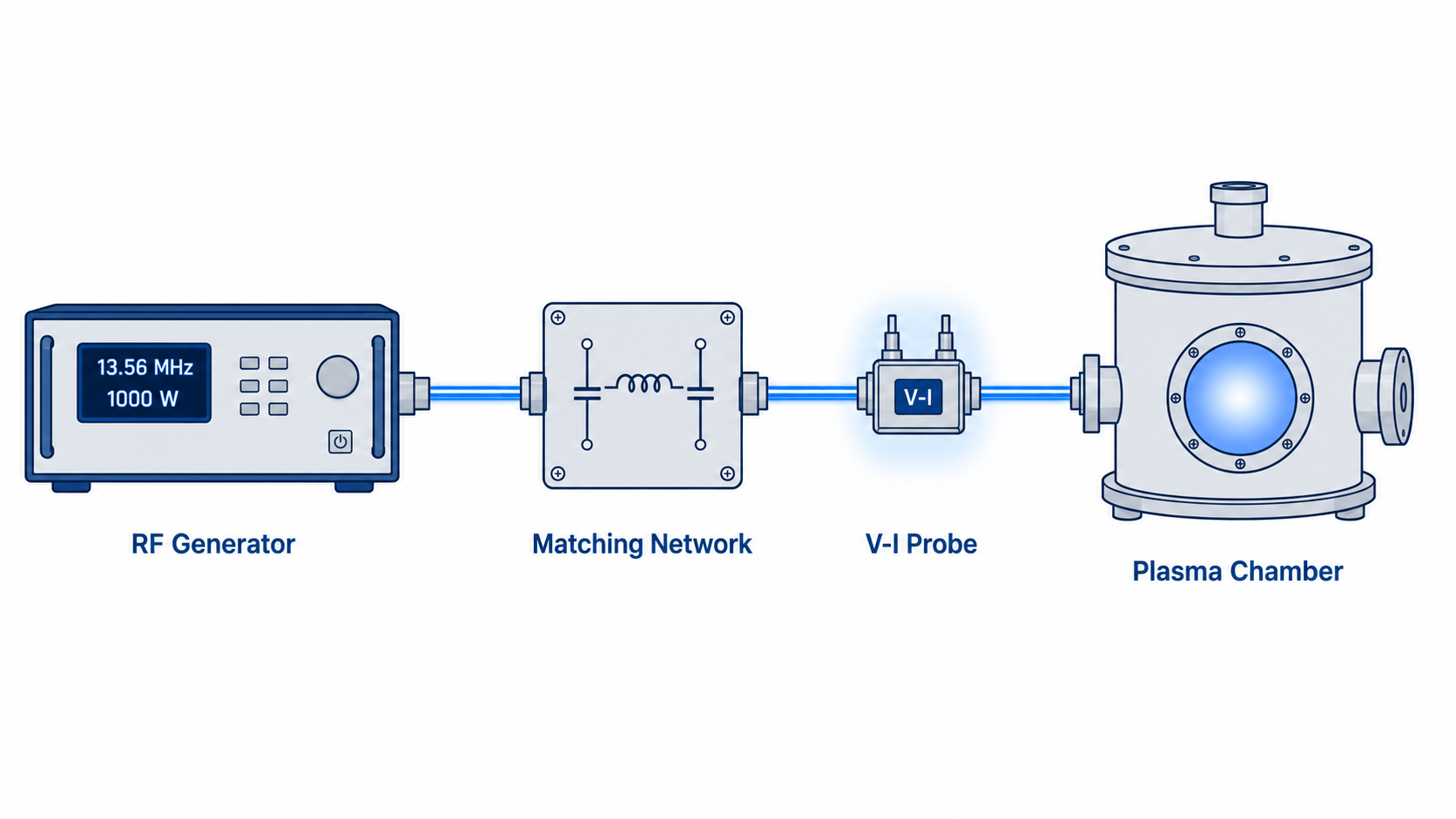
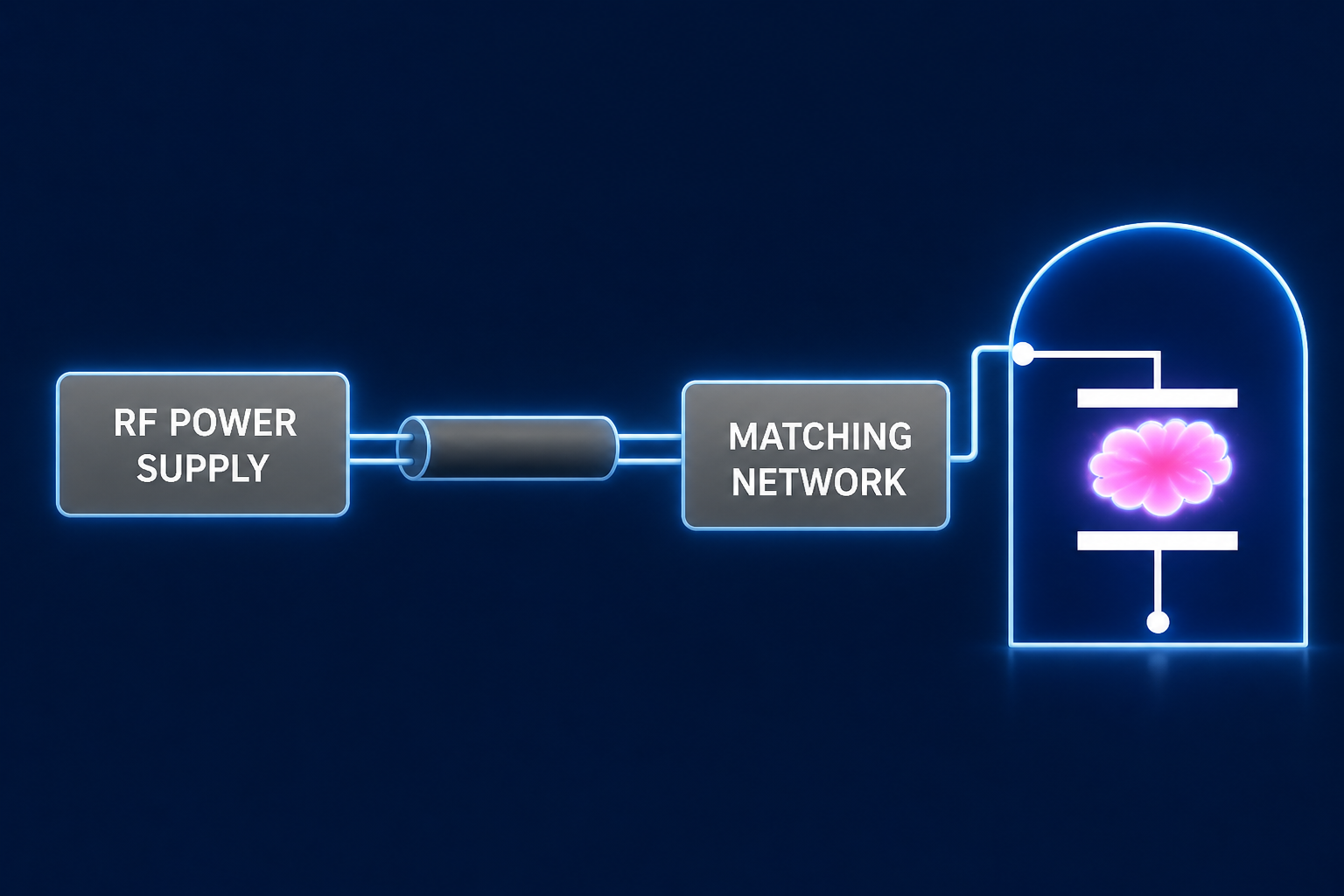
RF power reaches the plasma through a three-element delivery path shown in Figure 1: the RF generator, the coaxial transmission line, and the matching network. The challenge is ensuring that the power specified by the fabrication recipe flows through each element and into the plasma chamber at the correct level. That requires both periodic maintenance and real-time continuous RF power monitoring.
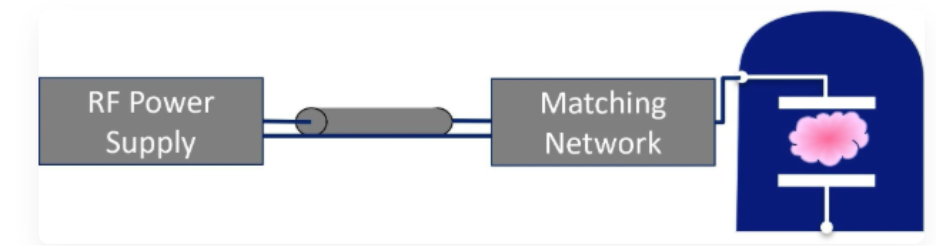
Figure 1. Components of the RF power delivery path
RF Generator
Remote Placement and Access Constraints
RF generators in semiconductor fabs are typically installed in an equipment chase remote from the process tool. This placement reduces floor congestion, improves thermal stability, and reduces vibration exposure. Remote placement also means the generator is not easily accessible while the tool is running, making periodic inspection and continuous remote RF power monitoring essential.
Periodic Inspection
Generator performance drifts with component aging. Inspections should occur at intervals no longer than the manufacturer's recommended recalibration interval. Key parameters to verify include:
- Setpoint drift — actual output power may shift from the programmed setpoint over time
- Linearity errors — output power should have a fixed proportionality to any setpoint across the full operating range
- Output stability — amplitude and frequency must remain constant under steady-state conditions
Maintaining these parameters within the manufacturer’s specifications is essential for enabling the RF generator to deliver the required output power.
Example RF Generator Problem
An example of a problem that negatively impacts wafer yield is RF generator setpoint drift. Variation of the output from the programmed setpoint beyond the generator’s specifications results in power delivery outside the tolerance range required by the process recipe. Testing the RF generator revealed the setpoint drift, and recalibration resulted in bringing the generator back into specification, eliminating the problem.
Transmission Line
The coaxial cable connecting the generator to the matching network adds insertion loss to the delivery path. Cables degrade over time, and connectors wear with repeated use, reducing delivered power to the plasma. Cable insertion loss should be measured at each generator inspection interval. In addition, VSWR or return loss measurements can indicate a cable or connector fault. A significant increase in VSWR or reduction in return loss represents a deviation from the cable and connector’s 50 Ω characteristic impedance, suggesting a breakdown in cable or connector characteristics.
When insertion loss increases or VSWR increases (and return loss decreases), the generator setpoint requires upward adjustment to maintain correct delivered power. Trending these parameters over time distinguishes normal gradual degradation from sudden changes that can indicate connector failure or physical cable damage.
Avoid the Misinterpretation Trap
The RF generator is outputting the correct power level required by the recipe, but the processing results are outside the tolerance limits. Both VSWR and return loss measurements are within system specifications. In fact, they have improved compared with previous measurements. However, RF power at the matching network has fallen below the required delivered power level. Testing the cable insertion loss indicates that it has substantially increased. Further investigation reveals a kink in the cable requiring replacement, restoring the correct power to the matching network.
Trusting VSWR or return loss alone can result in misinterpreting results because increased impedance lowers reflected power, resulting in a lower VSWR or higher return loss. The system will appear to be satisfactory when it is not. Tracking insertion loss combined with VSWR or return loss measurements during periodic maintenance provides a complete picture of system health and can avoid potential yield problems.
Matching Network
The matching network is an L-C circuit placed between the transmission line and the plasma chamber. Its function is to maintain a 50 Ohm resistive load to match the 50 Ω output impedance of the RF generator as plasma impedance changes during process recipe steps. The plasma has a dynamic impedance, ranging from a few ohms to hundreds of ohms, with a capacitive or inductive component that shifts continuously during processing steps. Without the matching network, a large fraction of generator output would reflect rather than couple into the plasma.
The network uses variable vacuum capacitors whose capacitance is adjusted by stepper motors that vary the distance between capacitor plates. This active tuning continuously transforms the plasma impedance to present a 50 Ω load to the generator. Because the capacitors are mechanically actuated, they are subject to wear. Periodic testing ensures that the mechanically controlled matching network operates within the manufacturer's specifications.
Reflected power is one of the primary indicators of matching network performance. Low reflected power confirms that the network is maintaining a good impedance match. Increasing reflected power at any point in the process recipe indicates a couple of possible problems. The capacitors or stepper motors may be degrading. The tuning algorithm has stopped working properly or is performing poorly. The third source of the problem could be improper setup of the matching network pre-sets.
Continuous, Real-Time Process RF Monitoring
Periodic inspection verifies equipment condition at a point in time. Continuous monitoring tracks the RF delivery system during process runs. Two power quantities must be monitored in real time:
- Forward power — the power delivered to the plasma, which must match the fabrication recipe specification
- Reflected power — the power returned toward the generator, which indicates matching network performance and impedance match quality
While the RF generator measures these parameters, independent, high-accuracy monitoring of forward and reflected power enables process engineers either to more easily maintain process quality or to more quickly identify a problem in power delivery and stop the process.
RF Measurement Solutions
Equipment engineers need the following measurement instruments for maintaining and monitoring their plasma processing RF power delivery system:
- Calibration cart — for periodic calibration of RF generator output, including setpoint accuracy, linearity, and stability
- High-Accuracy, In-Line RF Power Sensors — for continuous, real-time monitoring of forward and reflected power throughout process operation
- Cable Analyzer — for periodic measurement of transmission line insertion loss and VSWR, as well as identification of the location of a fault
Maintaining the RF Delivery Path for Maximum Yield
Continuous real-time monitoring ensures the RF system delivers the power the fabrication recipe demands on every process run. Periodic inspection confirms that each element of the RF delivery path, the generator, the cable, and the matching network, is operating within specification. Together, these practices reduce process variation, maximize RF power delivery system uptime, and protect yield.
Bird Technologies, with decades of experience in RF measurement for the semiconductor industry, offers a full portfolio of products for testing and monitoring the RF delivery path.
While this note addresses the 50 Ohm, pre-matching network side of the RF delivery system, Bird also has solutions for monitoring the condition of the plasma itself on the other side of the matching network. Future blogs will detail solutions for direct insight into the state of the plasma during processing.
Maximize your RF system uptime and process yield with Bird’s assistance. Contact Bird for guidance with monitoring and maintaining the RF delivery path in your plasma etching and deposition tools.
Contact an RF Expert at Bird
Connect with a solutions expert for knowledgeable guidance.