
High-Accuracy RF Power Measurement for Advanced Semiconductor Plasma Processes
March 17th, 2026
5 min. read | By Martin Dummermuth

Why ±0.5% High-Power Accuracy Matters for Process Control at Advanced Nodes
RF Power Measurement Is Becoming a First-Order Yield Variable
As semiconductor manufacturing advances into the angstrom era, plasma process control is entering a tightly compressed control window, where small deviations can have disproportionate consequences. High-aspect-ratio etch, atomic layer etching (ALE), selective deposition, and multi-frequency pulsed RF architectures are compressing process windows to levels that were inconceivable a decade ago.
In this environment, RF power is no longer a background utility parameter. It is a primary driver of plasma density, ion energy distribution, film growth kinetics, and feature profile fidelity. Measurement uncertainty that once appeared negligible can now translate directly into line-width variation, critical dimension drift, and yield excursions.
For advanced-node fabs, the question is no longer simply “What power is the generator set to?” It is: “With what level of certainty do we know the power actually delivered to the plasma?”
As device geometries shrink and tool-to-tool matching becomes increasingly stringent, RF metrology accuracy, particularly at high kilowatt power levels, is emerging as a strategic control variable. Achieving ±0.5% accuracy at tens of kilowatts is not merely a specification challenge. It directly affects process stability, excursion control, and yield performance.
RF Power Is the Control Lever Inside the Plasma
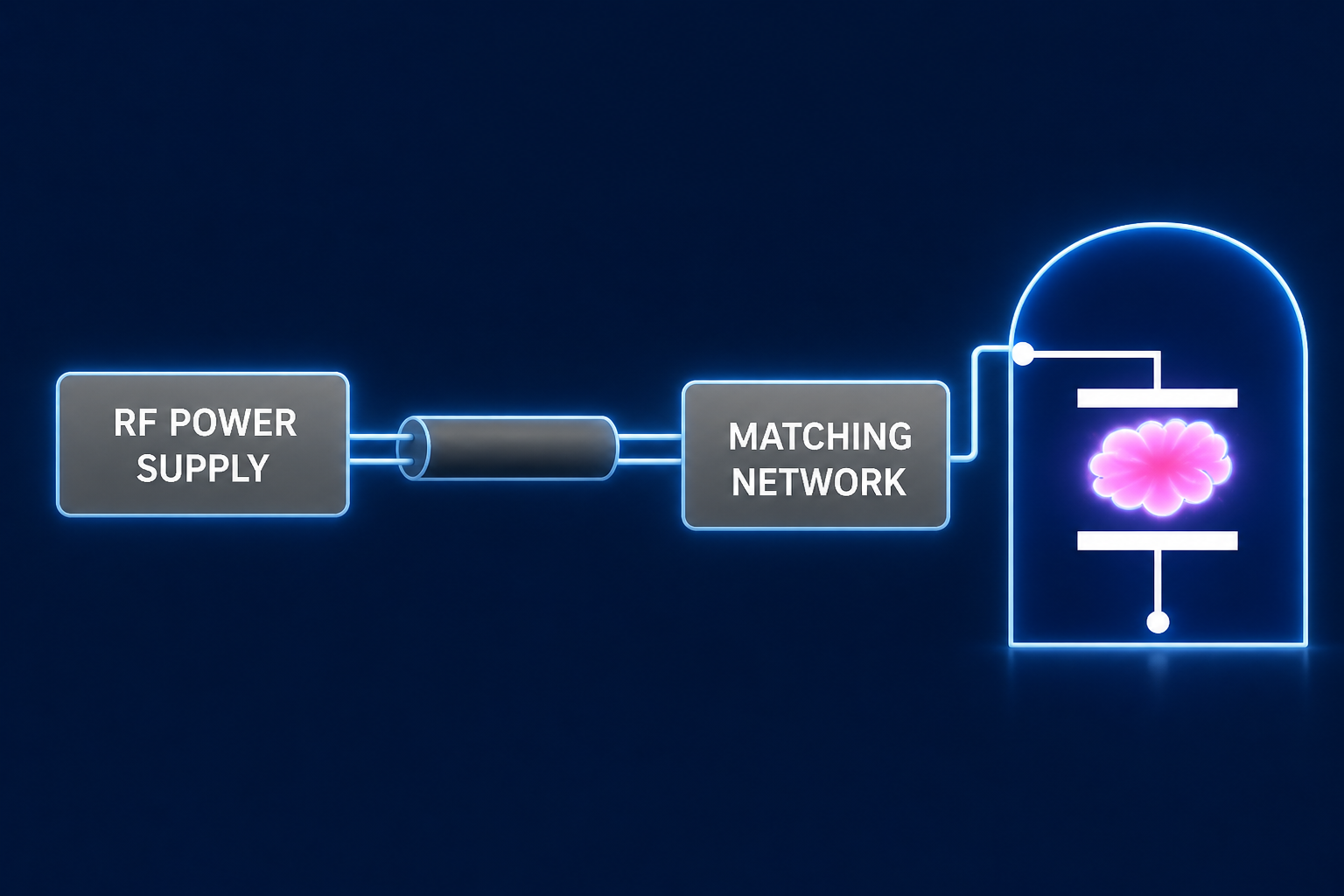
Plasma-based semiconductor manufacturing depends on precisely controlled RF energy to sustain and shape the plasma environment inside the process chamber. Whether the objective is material removal, selective etching, or ultra-thin film deposition, RF power directly influences plasma density and the ion energy distribution at the wafer surface. Those two variables — density and ion energy — determine etch rate, deposition rate, uniformity, selectivity, and ultimately feature fidelity.
As device dimensions shrink and aspect ratios increase, even small deviations in delivered RF power can shift plasma behavior enough to narrow the effective process window. Achieving stable plasma conditions, therefore, requires more than a nominal power setting at the generator. It requires confidence that the actual power delivered to the chamber remains linear, repeatable, and accurate across the full operating range used in production.
A variation in delivered RF power of 1% to 2% can shift ion energy distributions enough to alter etch profile, sidewall angle, or film thickness uniformity. In high-aspect-ratio structures, these shifts can reduce selectivity margins or increase defectivity. Across multiple chambers, even small differences in delivered power can widen the tool-to-tool matching bands, increasing the probability of excursion and complicating statistical process control (SPC).
In advanced 3 nm and 2 nm logic nodes, particularly in gate-all-around nanosheet transistor architectures and high-aspect-ratio (HAR) etch structures, RF power tolerances must become even tighter. In these structures, even small shifts in ion energy distribution can alter profile angle, sidewall integrity, or selectivity performance. Pulsed RF technology, now widely deployed to achieve greater control of ultra-thin film deposition and selective etching, adds another layer of complexity. Engineers must now measure not just average power but also the pulse power levels, often at repetition rates exceeding 10 kHz. RF power measuring equipment must be accurately calibrated not only for CW power but also for pulse power.
Without traceable high-power calibration and verified linearity across the operating range, measurement drift can mask process drift, complicating root-cause analysis during yield excursions. RF process control is not simply about setting a power level, it is about knowing, with high confidence, exactly how much power the RF source is delivering to the plasma.
The Technical Challenge: Accuracy at High Power
Achieving 0.5% accuracy at RF power levels reaching tens of kilowatts presents unique engineering challenges. Most laboratory RF power sensors are calibrated at milliwatt levels and rely on diode detector technology. Diode detectors, however, exhibit inherent nonlinearity, typically 1 to 2%, that limits their achievable accuracy, particularly over wide dynamic ranges. Extending that calibration baseline to the kilowatt levels further compounds uncertainty, as tiny errors at low power scale dramatically at high power.
Three key technologies solve the challenge:
-
RF sensors based on a high-speed direct-sampling analog-to-digital (A/D) converter
-
Calorimetric calibration at elevated power levels
-
High-accuracy linearity characterization of the sensor
High-speed A/D converters offer superior linearity compared to diode detectors. By directly sampling the RF signal at high frequencies, a well-designed sensor can characterize the waveform with far greater fidelity across a wide dynamic range. The sampling technique can achieve high linearity, the key enabler of consistent accuracy across the sensor’s power range. The design challenge lies in selecting A/D technology with sufficient resolution and sampling rate to obtain tight linearity, then applying precision signal conditioning to maintain that linearity across all operating conditions.
Calorimetry provides the second critical pillar. By calibrating sensors at 1.7 kW using precision calorimetric technology, Bird engineers achieve a far more accurate, higher-power baseline, which can then be used to make a more accurate, higher-power measurement than is possible by extrapolating from a milliwatt-level calibration. At 1.7 kW, a properly designed calorimetric system can achieve less than 0.1% absolute accuracy, yielding a better-than-4:1 ratio between the calibration system’s accuracy and the sensor’s specified accuracy. This ratio is the standard benchmark for a robust, traceable calibration.
The third technology is a novel proprietary linearity characterization technique that measures residual sensor nonlinearity. The high accuracy of the technique ensures the correct amount of uncertainty is included in the sensor’s total uncertainty budget, allowing the specified sensor accuracy to be ±0.5% over the full operating power range.
Together, these technologies enable ±0.5% high-power accuracy across the full operating range. The ±0.5% specification is NIST-traceable and holds across the entire dynamic range.
RF Measurement Uncertainty and Yield Improvement in Semiconductor Fabs
Process engineers pursue yield improvement in semiconductor manufacturing at every stage of the production process. When the uncertainty of the RF power measurement decreases, the process window can be tightened around an optimal set point, reducing deposition and etch variability, improving uniformity across the wafer, and ensuring consistency from run to run and tool to tool.
The return on investment in higher-accuracy RF monitoring of the RF source can be substantial. Reducing RF measurement uncertainty enables tighter control bands around optimal process setpoints, lowering excursion probability and reducing wafer scrap associated with plasma instability or chamber mismatch. If a fab processes thousands of leading-edge computing wafers per month, each worth thousands of dollars, the reduction in scrap can save over a million dollars per month.
Proven RF Metrology at Production Power Levels
Bird has engineered RF power measurement systems for more than eight decades, spanning laboratory calibration environments and high-power field applications. That experience informs the design of its semiconductor-grade sensors, where linearity, calibration integrity, and stability at production power levels are paramount.
The 7037 and 7039 Precision RF Power Sensors integrate high-speed direct-sampling A/D architecture with elevated-power calorimetric calibration and NIST-traceable uncertainty control. The result is ±0.5% accuracy maintained across the full dynamic range — from 10 W to 60 kW — and across both CW and pulsed RF operation. Multi-state pulse analysis (up to four levels) and repetition rates from 10 Hz to 100 kHz ensure accurate characterization of modern bias modulation schemes, while harmonic filtering preserves measurement integrity in electrically noisy plasma environments.
In advanced semiconductor manufacturing, RF measurement accuracy directly influences process window stability, chamber matching, and run-to-run repeatability. As nodes shrink into the 1-3 nm class and pulsed RF architectures become standard, uncertainty margins tighten and measurement fidelity becomes increasingly consequential.
±0.5% high-power accuracy is achievable today through calibrated direct-sampling architectures and elevated-power traceable calibration methods, with ongoing improvements targeting even tighter uncertainty control.
RF Metrology as Process Infrastructure
As advanced-node manufacturing continues to tighten process tolerances, the margin for measurement uncertainty will continue to narrow. The shift toward pulsed RF architectures, multi-level bias control, and increasingly complex impedance-plasma environments will further underscore the importance of high-linearity, high-power metrology.
The next phase of semiconductor innovation will require more than incremental improvements in RF measurement. It will demand:
- Tighter uncertainty budgets
- Higher linearity across wide dynamic ranges
- Accurate pulse-state characterization
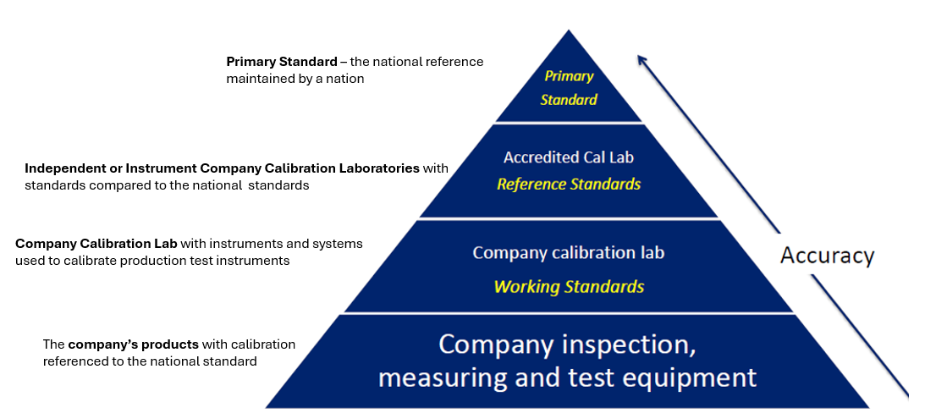
- Calibration hierarchies that scale to real operating power
- Measurement systems robust enough for electrically noisy plasma environments
- RF metrology is becoming part of the process infrastructure itself — as foundational to yield control as temperature, pressure, or gas flow.
With decades of experience in high-power RF measurement and a focus on advancing calibration science, Bird is actively developing the next generation of precision RF sensors to support the semiconductor industry’s roadmap toward ever-tighter control regimes.
In the angstrom era, certainty matters. And measurement certainty begins at the RF source.
Related RF Measurement Resources:
Martin is Chief Technologist at Bird, where he leads the company’s technology strategy and development initiatives. With more than 25 years of experience in RF systems, his work focuses on high-accuracy RF power measurement and metrology. Marty previously worked on airborne radar systems at Northrop Grumman and holds several patents related to RF power measurement and semiconductor plasma monitoring. He is an IEEE Senior Member and co-chairs the SEMI North American RF Measurements Task Force.
Explore Posts by Topic:
Products Featured:
50 Ohm Inline Sensors
Monitor RF power continuously without interrupting the signal path
Contact an RF Expert at Bird
Connect with a solutions expert for knowledgeable guidance.