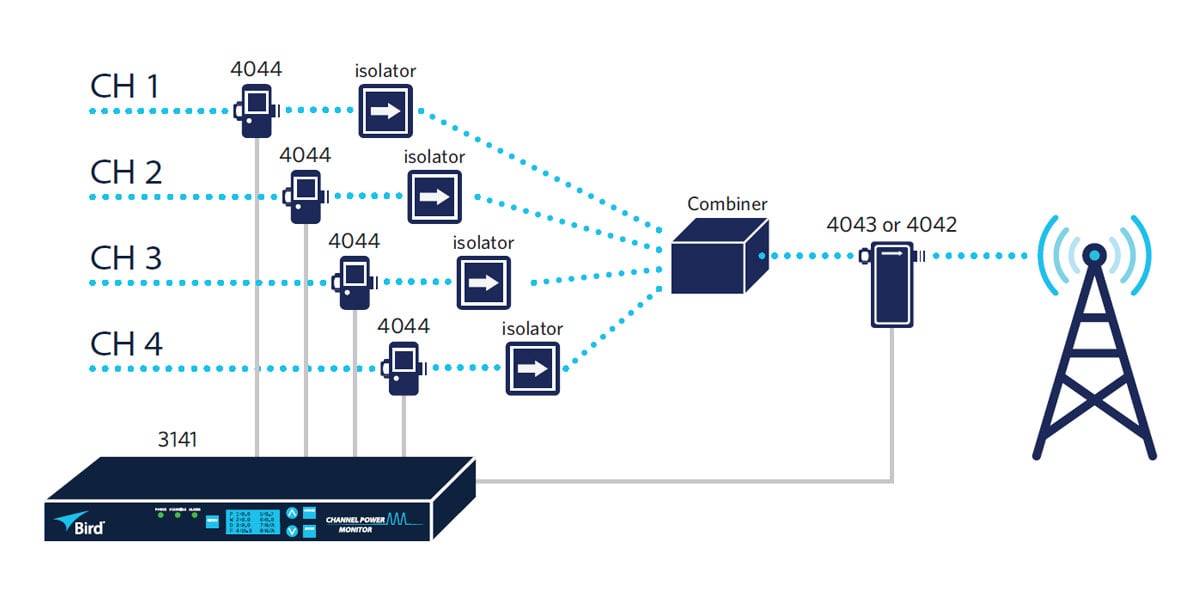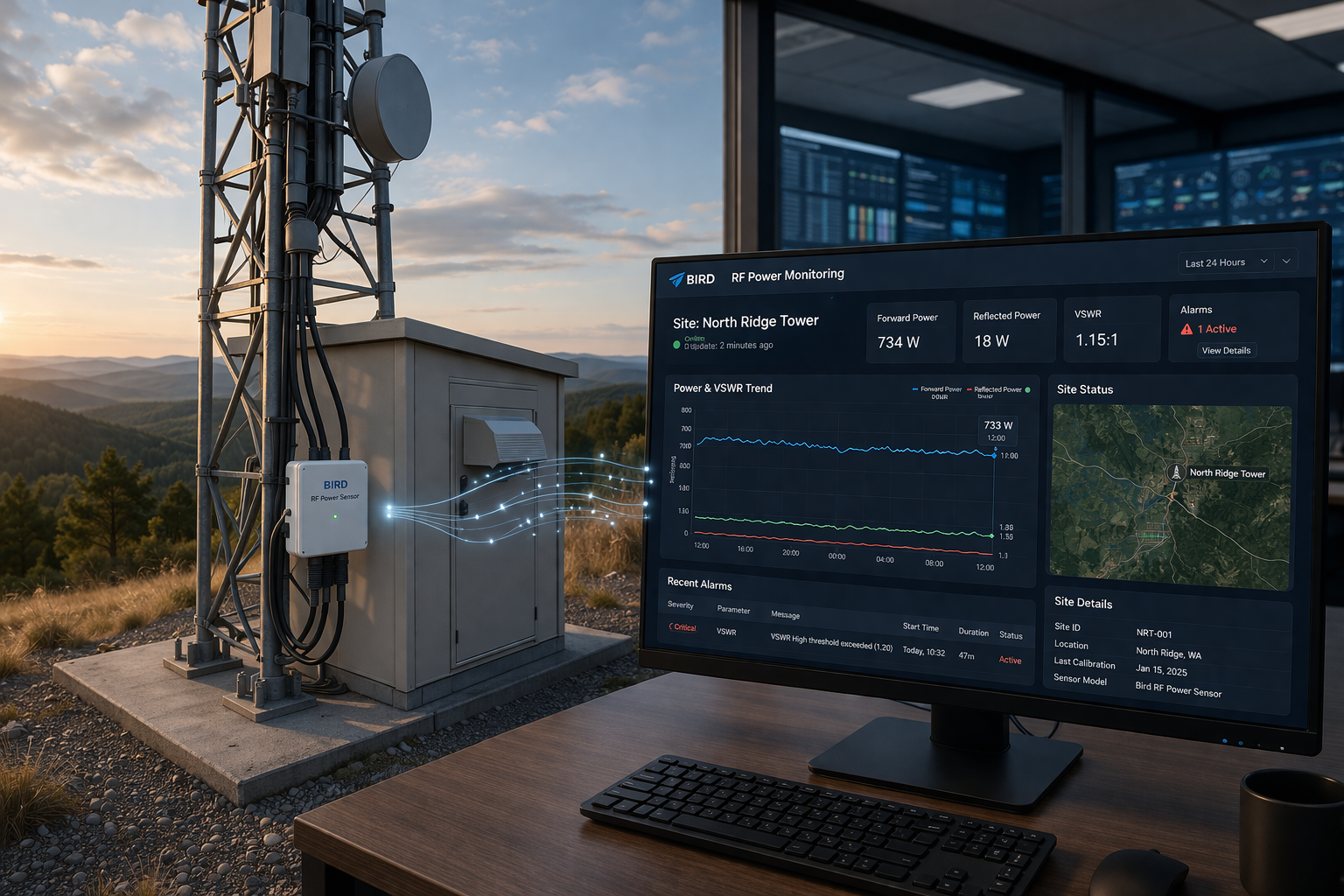

When a firefighter radios for backup or a utility operator sends a critical switching command across a remote telemetry network, they need their communication to be received. For the RF engineers and technicians responsible for keeping these systems running, understanding what to monitor and how to catch degradation before it becomes a failure can mean the difference between a proactive maintenance visit and an emergency truck roll at 2 a.m.
Mission-critical communication systems, including P25 (Project 25) supporting fire, police, and EMS across the United States, TETRA networks in Europe, ground-to-air aviation communications, and military tactical radio links — demand reliability measured in “nines.” Even 99.9% availability still allows more than eight hours of downtime per year. For first responder coverage, that’s unacceptable. For military command links or utility SCADA networks monitoring remote substations, the downtime can be catastrophic. This post examines the RF power-related failure modes that most often degrade your mission-critical communication system, the measurement data needed to detect issues early, and how a layered RF power measurement strategy helps you stay ahead of problems before they become outages.
What Degrades RF Performance — and Why It Happens Slowly
Most RF power-related degradation develops gradually.
Cable and connector losses creep up as corrosion and moisture take hold. Combiners and filters shift as seasons change and components age. There’s usually no obvious alarm until the system is already running on thin margins—then coverage drops during a real incident.
The most common contributors to degraded performance in mission-critical communication systems typically fall into three categories:
- Transmitter and Equipment Failures: A transmitter that drops output power by 3 dB delivers half the RF power to your antenna system. Across a multi-site network with dozens of transmitters, small reductions across multiple sites compound into significant coverage degradation. Combiner cavity drift, often driven by seasonal temperature swings in the radio shelter, adds additional insertion loss across specific channels. Isolator failures can silently reduce transmitter-to-transmitter isolation from 50–60 dB down to levels that allow unwanted coupling between adjacent transmit paths.
- Antenna Failures: Antennas fail in multiple ways: mechanical damage, loose or corroded connectors, broken elements, or gradual detuning. Each failure mode impacts system performance differently, and none of them is visible from the ground. Without measurement data, these changes often go unnoticed until coverage margins are already compromised.
- Cable Failures — The Hidden Threat: Coaxial cable is designed to last decades, but its construction makes it vulnerable to a persistent enemy: water. The construction of coaxial cable makes it vulnerable to moisture spreading along the outer conductor (the shield) by capillary action. The moisture corrodes the individual copper strands within the shield, causing them to no longer be one continuous outer conductor but rather lots of separate wires.
This deterioration is invisible from the outside. You may not see evidence until the jacket is stripped back and the braid shows dark green or black corrosion instead of bright copper. By the time it is visible, the cable may have been degrading system margin for months.
The impact is bidirectional and compounding. In the transmit path, higher insertion loss reduces the power reaching your antenna. In the receive path, that same added loss raises the noise figure of the receiver, reducing sensitivity and compressing coverage range from the most distant sites first. The disturbing fact is that VSWR alone may not reveal the issue. See the Sidebar.
Continuous Monitoring: What to Measure and Where to Measure It
The answer to gradual degradation is continuous, in-line monitoring. Use RF power sensors installed within the RF signal path that report real-time measurements and trigger alarms when key parameters drift outside defined thresholds. Relying on periodic site visits and manual spot checks alone often misses the slow-moving failures that characterize most communication system degradation.
Understanding where to place sensors and what each measurement represents is the foundation for an effective monitoring strategy. Figure 1 illustrates a typical multi-transmitter combiner system and common sensor placement.
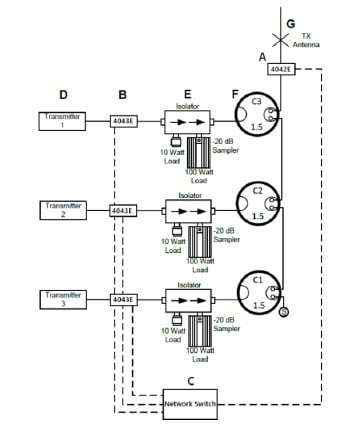
Figure 1. Remote in-line power sensors for RF power measurement integrated into a multi-transmitter communication system
Placing a directional power sensor (item B) at the output of each transmitter (item D), before the combiner, provides a transmitter-specific forward RF power measurement and lets you confirm that each transmitter is producing its expected output. At the combined output, between the combiners (item F) and the antenna (item G), install a sensor (item A) capable of measuring per-channel and composite forward power, reflected power, and VSWR. This sensor monitors the health of the entire antenna and feedline path.
Also, monitor the receive path (not shown in Figure 1) with a sensor at the receive antenna cable that can provide return loss and VSWR measurements. This sensor can indicate cable and connector degradation before it reduces receiver sensitivity. Select sensors with standard network connectivity (e.g., Ethernet/SNMP), so measurements and alarms can be integrated into your monitoring system.
From Reactive to Proactive: Building a Baseline and Catching Trends Early
Continuous monitoring delivers its greatest value when you have a baseline for comparison. After installation and system verification, document transmitter output power levels, combiner insertion loss per channel, cable VSWR and return loss characteristics, and receive path performance. That baseline becomes the reference point for every future measurement.
Example: Continuous Monitoring Maintains Link to the Furthest Locations
A major electrical utility operated polled telemetry networks monitoring remote transformers and switching stations. Periodically, the most distant sites would stop responding to polling requests — triggering expensive truck rolls to investigate. Field crews would inspect radios, cables, and antennas at the affected sites and find nothing wrong.
The problem was at the central polling site. Moisture had entered the coaxial cable feeding the central receiver, and corrosion gradually increased insertion loss in the receive path. The receiver's noise figure rose. Nearby sites still responded as their stronger signals masked the degradation. But signals from the most distant sites fell below the receiver's sensitivity threshold, causing them to disappear from the polling system. No alarm was activated to indicate a failure; there was just a growing quiet from the far edge of the network.
The solution was in-line receive path monitoring. With a sensor continuously measuring receive path performance against a documented baseline, that moisture-driven degradation would have appeared as a gradual loss, triggering an alarm before any remote site went silent. The utility has since deployed in-line RF power monitoring sensors across multiple regions of its grid network. For field verification and baseline documentation, a handheld cable and antenna analyzer lets you measure VSWR/return loss, insertion loss, and distance to fault at installation and on every maintenance visit. Store the initial measurements with your site records. The same test on a future visit immediately reveals whether — and precisely where — cable performance has changed.
When isolator performance is in question, comparing power readings across adjacent transmitter sensors can expose isolation loss long before it causes interference or transmitter stress. Depending on the combiner architecture, the cavity network may provide only single-digit to low-double-digit dB of isolation on its own, while a healthy isolator typically adds ~50–60 dB.
Bird Solutions for Monitoring Mission-Critical Communication Systems
Bird offers a complete portfolio of instruments and sensors for monitoring and maintaining mission-critical communication system infrastructure — from continuously operating in-line Ethernet-connected sensors to handheld field analyzers and all-in-one test kits.
Ethernet In-Line RF Sensors
Bird's Ethernet in-line sensor family installs directly in the RF signal path and provides continuous, real-time power measurements via web interface and Simple Network Management Protocol (SNMP), integrating into existing network monitoring systems for alarm-driven, remote visibility without daily manual intervention.
- 4043E Directional Ethernet RF Sensor: The 4043E measures forward power, reflected power, and VSWR for a single transmit path. Installed at the output of an individual transmitter (ahead of the combiner), it continuously verifies that each radio is delivering expected output and can alarm on drift over time.
- 4042E Channelized Ethernet RF Sensor: The 4042E provides visibility into combined or multi-carrier RF output measured at a single point in the RF path. It reports per-channel and composite forward power, reflected power, and VSWR, enabling operators to detect trends associated with insertion loss, combiner drift, or antenna and feedline issues at the site level from a single sensor location.
- 4046E Receive Path Ethernet RF Sensor: The 4046E monitors receive-path integrity by injecting a controlled test signal and measuring return loss at user-defined frequencies. Trending those measurements against an established baseline helps identify changes over time that indicate receive-path degradation (e.g., cabling/connectors) before it materially reduces receiver performance.
SiteHawk® Cable and Antenna Analyzer
The SiteHawk Cable and Antenna Analyzer is a handheld, field-ready instrument designed for simplicity and speed in the field. It measures VSWR/return loss and cable insertion loss, characterizes cable and antenna performance as a function of distance, and pinpoints cable faults with a distance-to-fault function. When compared against installation baselines, SiteHawk results quickly show whether performance has changed — and help locate where the change occurred. The instrument’s intuitive interface supports efficient testing, even for technicians who are not RF specialists.
RF Analyzer Kits
Bird's RF Analyzer Test Kits put everything needed for comprehensive cable, antenna, and transmitter verification in a single, field-ready package. A kit can include the SiteHawk Cable and Antenna Analyzer, a 50 Ohm termination load, cable adapters, a wideband RF power sensor, and the SignalHawk® Spectrum Analyzer. Whether you’re commissioning a new site, conducting a periodic maintenance sweep, or troubleshooting a reported performance issue, the RF Analyzer Kit equips your technicians with the complete RF power measurement capability to characterize the system and isolate faults without hunting for the right tools across multiple cases and cabinets.
Putting It Together: A Monitoring Strategy Built for Mission-Critical Reality
The RF systems supporting first responders, utilities, military users, and industrial operators are too important to manage reactively. Most performance-eroding failure modes share a common trait: they develop gradually, and they can be detected early, before they turn into a coverage or availability failure.
An effective monitoring strategy combines:
- Continuous in-line measurements at transmitter outputs, the combined antenna port, and the receive path
- Alarm thresholds referenced to documented baselines
- Field-ready test tools for periodic verification and rapid fault localization when alarms trigger.
Bird brings 80 years of RF power measurement expertise to mission-critical communication infrastructure. From continuous in-line monitoring sensors to field analyzers and RF test kits, Bird solutions help operators detect RF performance changes earlier and respond before reliability is affected.
Whether you are designing a new monitoring architecture or troubleshooting chronic reliability issues on an aging system, Bird's application engineering team can help you identify the right sensor placement strategy and RF power measurement approach for your specific system.
Contact us to discuss how continuous RF power monitoring can maximize uptime and reduce unplanned maintenance costs across your mission-critical communication network.
SIDEBAR: Your VSWR Is Lower — Is That Always Good?
Quick Scenario
During a maintenance check, you notice VSWR has actually decreased since your last measurement. Sounds like good news — right? Not necessarily.
What's Happening
If you are seeing lower output power than expected, something is wrong. Here's the paradox: as moisture intrusion and corrosion increase insertion loss in your coaxial cable, forward power drops and reflected power drops even more sharply as it is attenuated in both directions. Return loss increases, the reflection coefficient decreases, and the ratio between forward and reflected voltages shrinks — making the apparent mismatch look better.
VSWR is related to return loss by the following formula:

As return loss increases, VSWR decreases.
The Risk
Your RF power is being converted to heat inside the cable, not radiated from your antenna. A lower VSWR reading in this scenario is a false indicator of system health.
Key Takeaway
VSWR alone is not sufficient to diagnose what's really happening in your system. Always compare VSWR data with absolute forward power measurements and establish baselines so you can spot trends before they become failures.
Contact an RF Expert at Bird
Connect with a solutions expert for knowledgeable guidance.