Monitor what matters on the transmit side before issues become service impacting.
The 4042E and 4043E Ethernet RF sensors deliver continuous transmit path visibility into transmit path performance between site visits using standard Ethernet connectivity.
4043E | Transmitter output monitoring
Monitors each transmitter individually. Measures forward power, reflected power, and VSWR to confirm every transmitter is producing expected output within a defined frequency range.
4042E | Combined and per-channel monitoring
Monitors the combined RF output of multi-carrier systems, with per-channel and composite power and VSWR to identify insertion loss, combiner drift, or antenna and feedline issues at the site level.
Verify output and spot mismatch changes early.
See individual carriers or the combined signal based on site design.
Detect change between visits and reduce urgent dispatches.
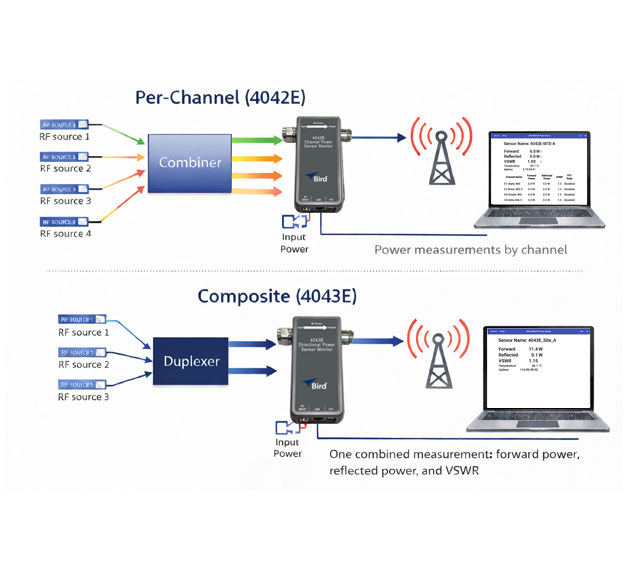
RF monitoring can be implemented in different ways depending on where you need visibility in the RF path. Site design, system complexity, and operational goals all influence how measurements are made. Understanding these approaches helps ensure the right level of insight without unnecessary complexity.

Focuses on individual transmitters or carriers. Each channel is measured independently, making it easier to isolate changes that may be hidden in a combined signal.
This approach is often used when:
Individual transmitter performance must be verified
Carriers operate at different power levels
Isolating a single source of change is a priority
Measures the combined transmit output at a single point in the system. Forward power, reflected power, and VSWR provide a clear view of overall transmit path health and antenna or feedline match.
This approach is often used when:
Multiple carriers are combined through a shared RF path
Site level performance is the primary concern
Simplicity and broad coverage are preferred
Many systems use both channelized and composite monitoring to balance detail and efficiency. Channelized measurements help isolate individual changes, while composite monitoring provides a fast indicator of overall site health.
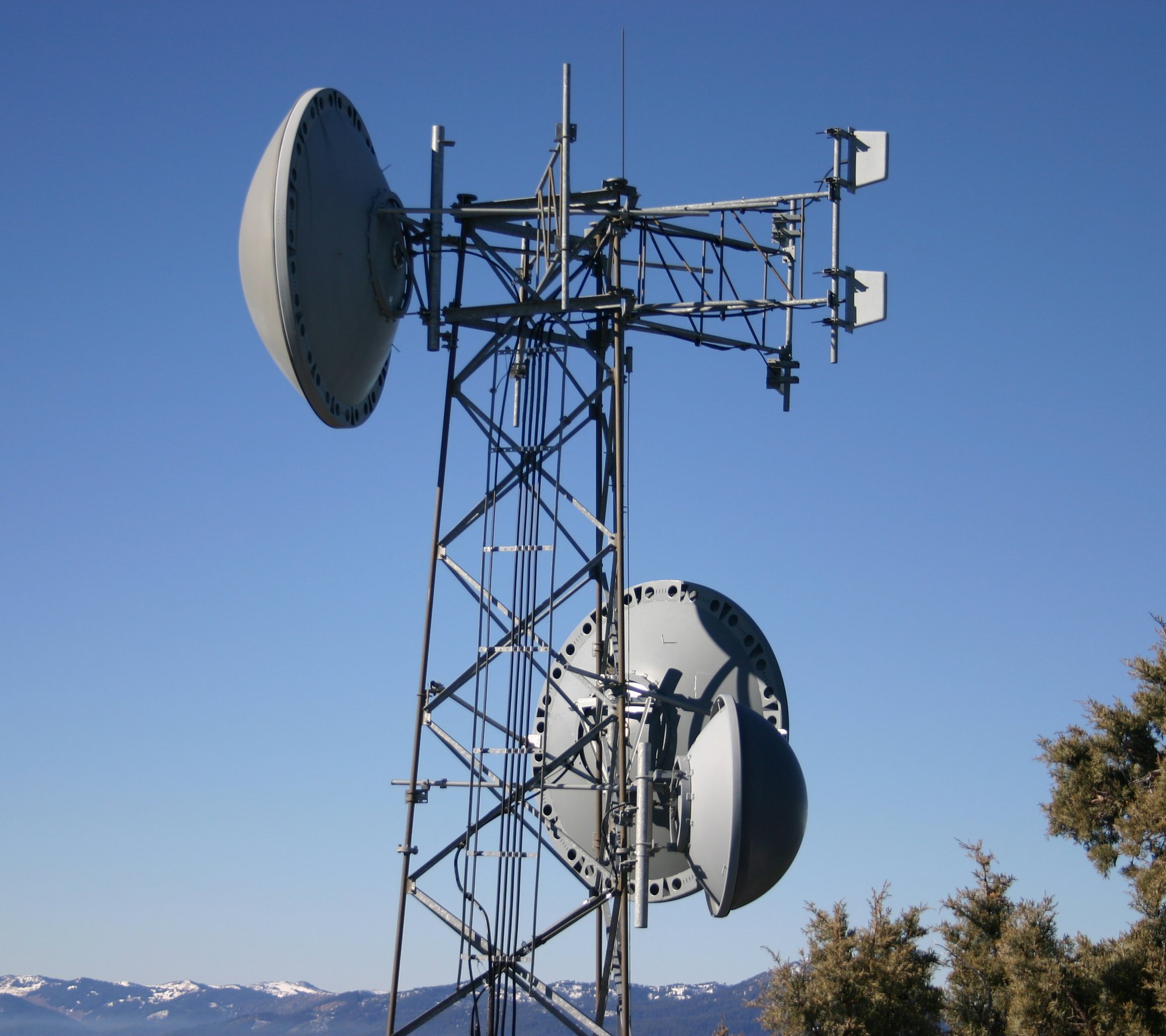
Small issues in the antenna and feedline often develop gradually. These changes can increase loss and mismatch long before a transmitter fault or outage is obvious.
Moisture intrusion increases loss and shifts return loss, reducing delivered transmit power.

Corroded connectors degrade impedance match, increasing reflections and RF loss.
Wind, ice, and vibration shift hardware, changing match and transmit efficiency over time.

Cable aging increases loss and noise until coverage degradation becomes service impacting.
Bird Ethernet RF sensors are built for continuous, remote visibility into transmit performance. Measurements are available through a built-in Web UI or integrated into existing network management systems using standard SNMP.
Web UI: View live forward power, reflected power, and VSWR. Configure sensors, channels, and thresholds through a secure browser-based interface.
SNMP Integration: Use SNMP GET and SET commands plus traps to feed measurements and alarms into your existing NMS.
Configurable Alarms: Set per-channel or composite thresholds with optional delay and latching to avoid nuisance alerts.
Trending Over Time:Track gradual changes in transmit performance and identify degradation before it becomes service impacting.
Role-Based Access: Password-protected configuration with separate administrator and standard user permissions.
Have more questions? Get Expert Help>
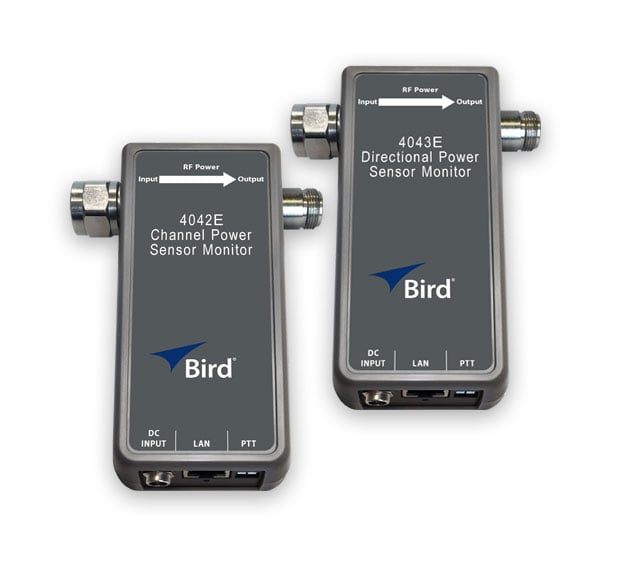
4043E monitors individual transmitter output using directional measurements. 4042E monitors multi-carrier systems with per-channel and composite visibility for overall site health.
If you need to verify or isolate changes on specific transmitters, per-channel visibility helps. If you want a fast indicator of overall transmit-path and antenna/feedline health, composite monitoring is often the right starting point. Many sites use both.
Yes. Some sites use per-transmitter monitoring for isolation and composite monitoring for overall site confidence. This combination provides both detail and simplicity.
No. Ethernet RF monitoring complements field testing by providing continuous, between-visit visibility and alarms. It doesn’t replace sweep testing, coverage testing, or acceptance measurements.
No. You can view measurements in the built-in Web UI or integrate into existing systems using SNMP.
Bird Ethernet RF sensors install in-line in the RF path. If connector types or genders are ordered incorrectly, the sensor may not mate to site cables, causing rework, delays, or the need for adapters.
RF direction is based on power flow.
Swapping RF IN and RF OUT connector types or genders—ordering the input connector to match the downstream cable and the output connector to match the upstream cable.
4042E and 4043E focus on transmit-side monitoring. 4046E is designed for receive antenna health monitoring where gradual degradation is often missed until coverage complaints.
Compare Ethernet RF sensor models by what they monitor and their RF measurement range.
Not sure whether you need per-channel monitoring, composite monitoring, or a combination of both? Sensor selection depends on site architecture, transmitter layout, and what level of visibility you want into the RF path.
Bird’s Applications Engineering team can review your site and recommend the right Ethernet RF sensor configuration for your system.