
HF Communications: Why 2–30 MHz Still Beats the Satellite
June 17th, 2026
5 min. read | By Katie Wright
What Makes the 2–30 MHz HF Band Unique
HF communications use the 2–30 MHz band to deliver long‑range, beyond‑line‑of‑sight links without relying on man‑made infrastructure. Instead of towers or satellites, HF depends on the ionosphere, enabling 3,000 km‑plus paths that keep ships, aircraft, and government networks connected when higher‑frequency systems fail.
The HF band sits between 2 MHz and 30 MHz, corresponding to wavelengths from roughly 100 m down to 10 m. Those wavelengths are short compared to LF and MF, but long enough that the ionosphere can refract energy back to Earth. Typical single‑hop skip distances run from about 500 km up to 3,000+ km, depending on frequency, takeoff angle, and current ionospheric conditions.
Unlike VHF and above, where line‑of‑sight dominates, HF routinely bypasses the horizon. That is why an 8.291 MHz distress call from a cargo vessel 800 miles offshore can reach a maritime rescue coordination center in under two minutes, even with a failed satellite link and no coastal infrastructure in sight.
From a regulatory standpoint, HF is one of the most tightly managed parts of the spectrum. The ITU designates it as Region 1 Band 7, with detailed sub‑allocations for maritime, aeronautical, broadcast, amateur, military, and fixed services. For engineers, that translates into strict frequency planning and careful attention to spectral purity and spurious emissions.
How Ionospheric Propagation and Skip Shape HF Links
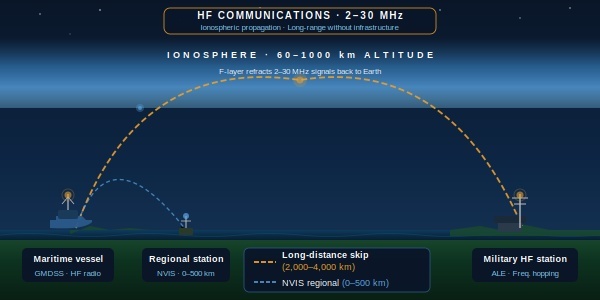
At HF, the ionosphere is your “space segment.” Layers of ionized gas between about 60 km and 1,000 km refract 2–30 MHz signals back toward the surface. The lowest usable frequency (LUF) and maximum usable frequency (MUF) for a given path shift hour‑to‑hour with solar illumination, season, and the 11‑year solar cycle.
When an HF signal leaves the antenna at a takeoff angle, it travels upward until the ionosphere bends it back down. Where it returns to Earth is the skip distance; between the transmitter and that landing point is the skip zone, where signal strength can drop dramatically. A 10 MHz link might show a first hop around 1,500 km, leaving a large quiet zone that VHF repeaters or NVIS techniques must fill.
Day/night changes reshape this picture. During daylight, the D‑layer absorbs lower HF (roughly 2–10 MHz), so links favor higher frequencies closer to the MUF. At night, the D‑layer largely disappears, allowing 3–8 MHz paths to open for thousands of kilometers at modest power levels, sometimes just tens of watts.
Modern channel models such as the ITU Watterson model and ITS statistical models treat the HF path as a fading, dispersive medium with Doppler spread and time‑varying delay. Recent research on non‑stationary HF channels for near‑space platforms shows that motion adds additional Doppler and delay variation, which wideband HF waveforms and interleaving schemes must handle to keep error rates acceptable.
Who Still Depends on HF and What They Require
Multiple critical sectors rely on HF precisely because it does not need towers, fiber, or functioning satellites. Maritime, military, aviation, amateur, broadcasting, and disaster‑response organizations all keep HF in their communications architectures as either a primary path or an engineered backup of last resort.
In maritime operations, ocean‑going vessels typically run 150–400 W HF transmitters into efficient antennas over a salt‑water ground plane. Under the GMDSS framework, HF Digital Selective Calling (DSC) on channels like 8.291 MHz lets a ship raise a rescue center thousands of miles away in seconds, even after a power failure or satellite outage.
Military forces deploy frequency‑agile, ALE‑enabled HF systems across the full 2–30 MHz range. Third‑generation ALE per MIL‑STD‑188‑141 can evaluate dozens of channels and lock a link in under one second, while STANAG and modern wideband HF waveforms push encrypted voice, email, and situational data to mobile units and ships with no dependency on local infrastructure.
Aviation uses HF to extend communication beyond VHF coverage on oceanic and polar routes. SELCAL tones allow controllers to alert a specific aircraft without forcing crews to monitor noisy HF audio continuously, while ACARS over HF carries position and weather data as a backup to satellite data links. Amateur radio and emergency‑service groups fill in the gaps on the ground, regularly providing the only connectivity into disaster zones via 3.5, 7, or 14 MHz links running on portable power.
Designing Antennas, Power, and Matching for HF Systems
HF hardware design starts with the antenna, because every other block in the chain must compensate for its size and placement constraints. A half‑wave dipole at 2 MHz is about 75 m long, whereas at 30 MHz it shrinks to roughly 5 m. Fitting useful radiators onto ships, vehicles, and crowded rooftops requires creative geometry and strong understanding of ground systems.
On a blue‑water vessel, a 10 m‑plus whip or backstay antenna over a conductive hull can provide efficient radiation from 4–22 MHz, provided the tuner and ground strap system are built to handle 150–400 W continuously. In land‑based NVIS systems, low horizontal dipoles at 0.1–0.25 wavelength above ground (for example, 8–20 m height at 3.5–7 MHz) trade long‑distance skip for solid 0–500 km regional coverage.
Power levels vary widely: 5 W “QRP” amateur rigs, 100–500 W tactical and maritime sets, and 250 kW shortwave broadcast transmitters driving large curtain arrays. Regardless of power, matching and VSWR control are non‑negotiable. A 400 W transmitter feeding a 3:1 VSWR mismatch reflects about 25% of its power—roughly 100 W—back into the finals as heat, shortening component life and shrinking link range.
Engineers use wideband or frequency‑agile tuners, high‑power terminations, and carefully routed feedlines to keep reflected power low across the operational band. Broadband HF antennas that cover 2–30 MHz without retuning exist, but they sacrifice efficiency at specific frequencies, a trade‑off that must be weighed against operational flexibility.
Planning Propagation, Managing Interference, and Staying Compliant
HF system design always includes a propagation plan. Tools like VOACAP and ITURHFPROP simulate 2–30 MHz performance by combining path geometry, solar flux, geomagnetic indices, and noise statistics to estimate LUF, MUF, and expected SNR throughout the day. This lets engineers build frequency schedules and ALE channel lists tuned to real‑world conditions.
For example, a transatlantic link might schedule 18–22 MHz channels during high solar activity and daylight, then pivot to 6–10 MHz at night. A regional emergency network using NVIS may standardize on 3–7 MHz, validating usable paths at 0–500 km range during both day and night through seasonal test exercises.
Interference is a constant at HF. Atmospheric noise, industrial emissions, and other legitimate HF services all compete inside just 28 MHz of spectrum. Receiver dynamic range and filtering must handle strong adjacent signals without desensitization, while transmitters need tight spectral masks to avoid splatter. ITU recommendations and national regulations specify harmonic and spurious limits that often require careful low‑pass filtering and regular verification.
Modern HF data applications also consider intermediate‑term variation (ITV) in channel quality. Studies presented to the HF Industry Association and documented by vendors like Isode show that speed‑adaptation algorithms based solely on very short measurement windows can oscillate. Link‑layer protocols such as STANAG 5066 tune packet lengths, interleaving, and rate changes to ride through ITV while preserving throughput.
Measurement Tools Every HF Engineer Should Know
Commissioning and maintaining HF equipment is ultimately about measurement. Engineers need to verify forward and reflected power, check antenna and feedline integrity, and confirm that transmitted spectra meet mask and allocation requirements. Skipping these checks turns subtle mismatches into degraded range—or outright failures when conditions worsen.
High‑power RF loads and terminations allow safe transmitter testing without radiating a live signal. A 250 kW shortwave transmitter, for instance, is typically brought up into a water‑cooled dummy load before being switched to the antenna field, ensuring that tuning errors or control faults do not damage the final amplifier stage.
In‑line wattmeters track forward and reflected power from HF up into the VHF and UHF ranges. For an HF system operating from 2–30 MHz and beyond, sensors that cover at least 25 MHz to several gigahertz can support multi‑band installations with a single monitoring infrastructure.
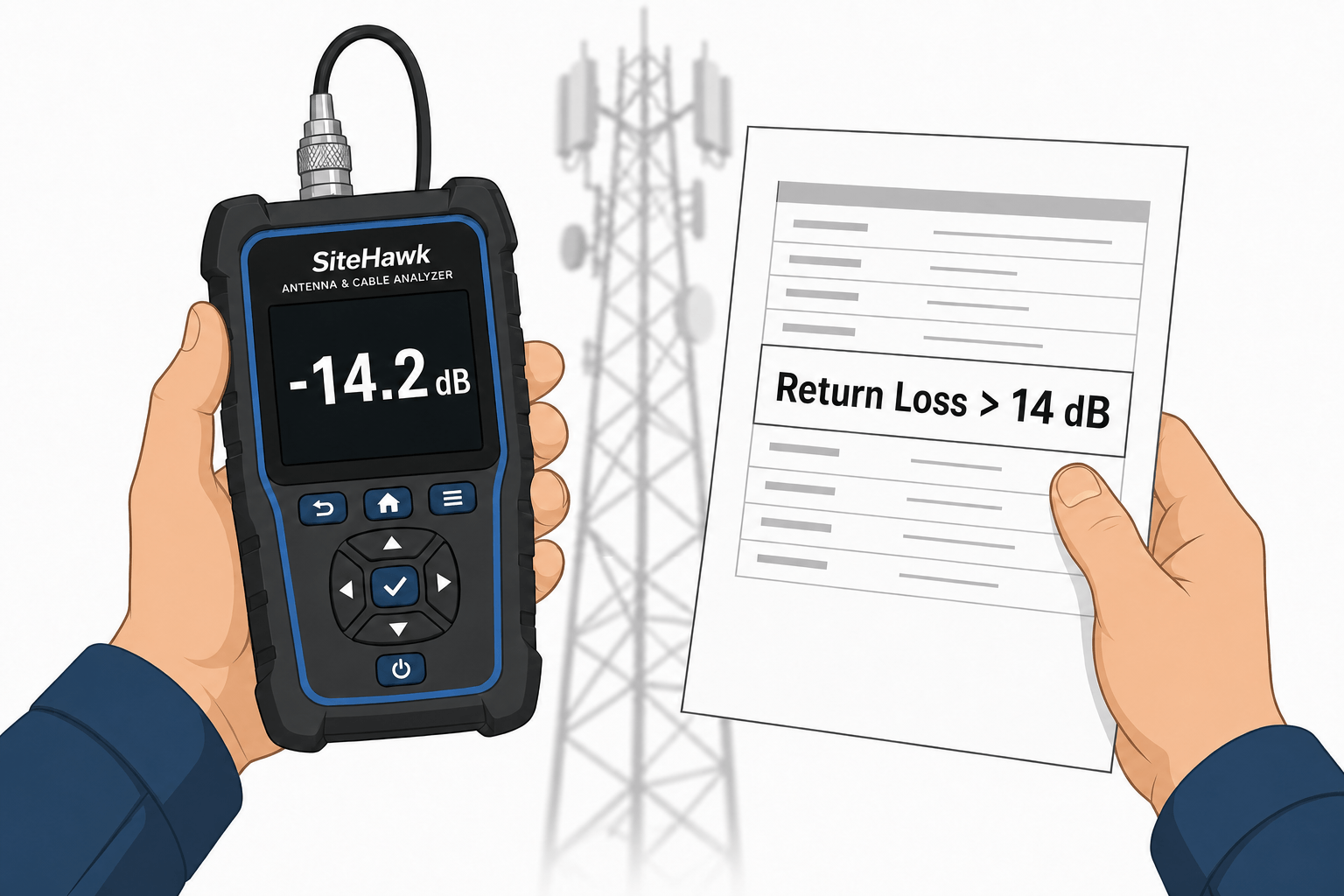
Handheld cable and antenna analyzers measure VSWR, return loss, and distance‑to‑fault along long HF feedlines, which may run tens or hundreds of meters across ships, towers, or antenna farms. When a 400 W maritime set suddenly shows rising VSWR at 12 MHz, a quick sweep can reveal whether the issue lies in a corroded connector 30 m from the radio or a damaged radiator at the masthead.
Finally, handheld RF spectrum analyzers give field teams a real‑time view of the HF band. Engineers can verify that transmitters are on‑frequency, confirm that harmonics and spurious emissions meet regulatory limits, and identify unexpected interference sources before they compromise critical 2–30 MHz links.
Katie is an electrical engineer with more than 30 years of experience in RF test and measurement. She specializes in high-power RF measurement, product strategy, and technical thought leadership. During her time at Bird, she wrote about RF measurement accuracy, calibration, and the applications of high-power RF systems. She is also a licensed amateur radio operator (KD8FAD).
Explore Posts by Topic:
Contact an RF Expert at Bird
Connect with a solutions expert for knowledgeable guidance.