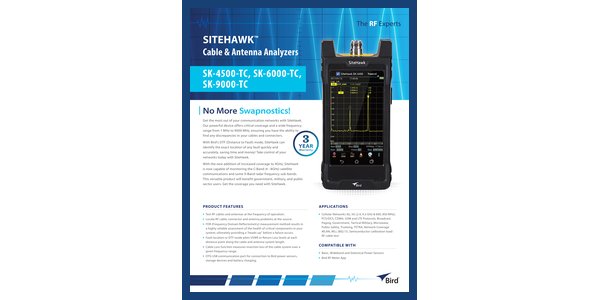
Bird Cable & Antenna Testers are used in the field and in the lab to tune antenna frequencies, measure cable loss, and determine the distance to faults in RF systems.
before install or while troubleshooting
without hand-over-hand checking
of lines before use
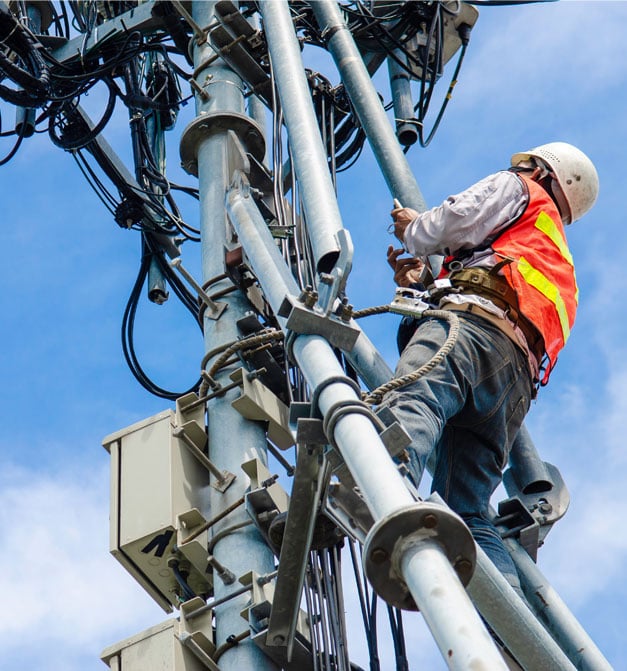
Errors during RF installs are costly—especially when a second tower climb is on the line. Bird SiteHawks help you verify performance on the spot or quickly zero in on faults when issues arise.
Bird’s SiteHawk Cable & Antenna Analyzers give pros—with or without RF experience—the clarity and speed to troubleshoot systems accurately. Built for the field, trusted in the tower, SiteHawk delivers lab-grade precision in a rugged, portable form, so you can diagnose issues right the first time, even under pressure.
Measure RF cables and antenna performance at operating frequency—up to 9 GHz—confidently.
Locate faults with precision using Frequency Domain Reflectometry (FDR), whether they’re 10 feet or 1 kilometer away.
Exportable, repeatable data makes site validation fast, simple, and fully documented.
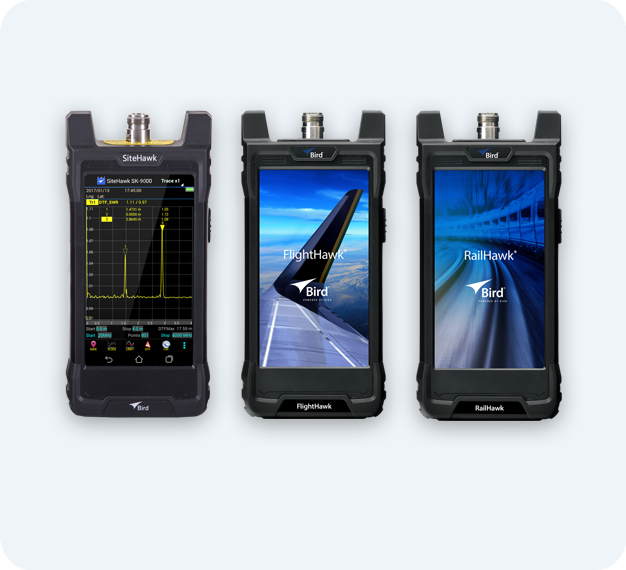
Bird’s SiteHawk family fits your environment, frequency range, and workflow. Industry-specific versions add unique cable parameters and adapters.
SiteHawk is built for cable and antenna testing—rugged, under 2 lbs, and ready for the field. Looking beyond cable testing?
SignalHawk Spectrum Analyzer:
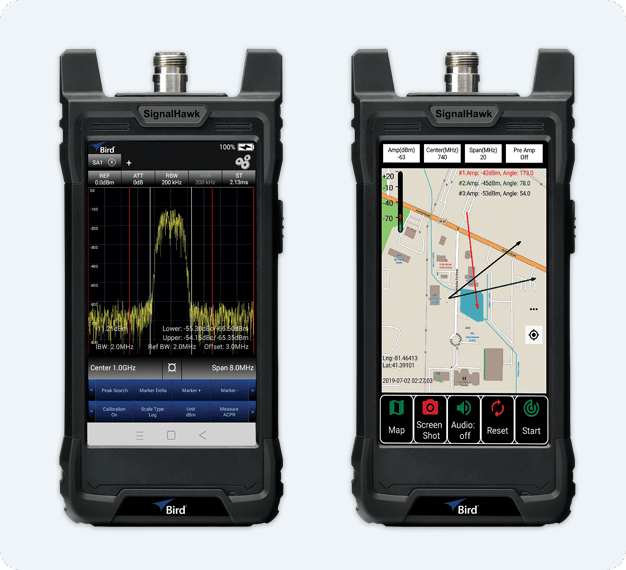
Reliable cable and antenna testing with total confidence.
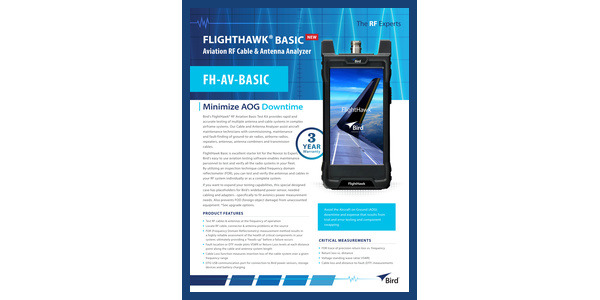
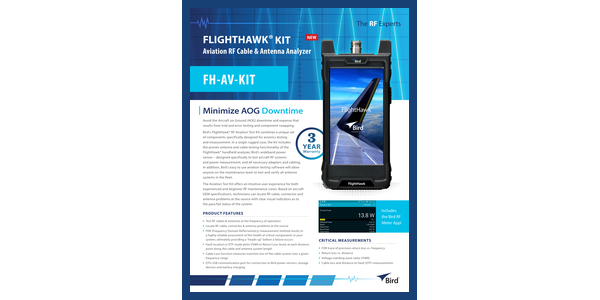
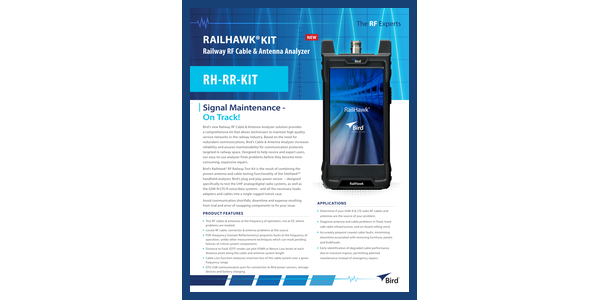
SiteHawk, FlightHawk, or RailHawk—designed for your environment.
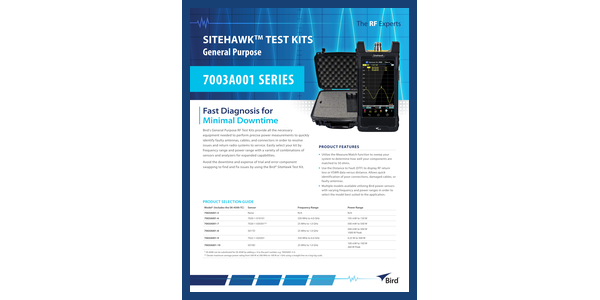
Select -4500, -6000, or -9000. Add sensors, cables, or kits as needed.
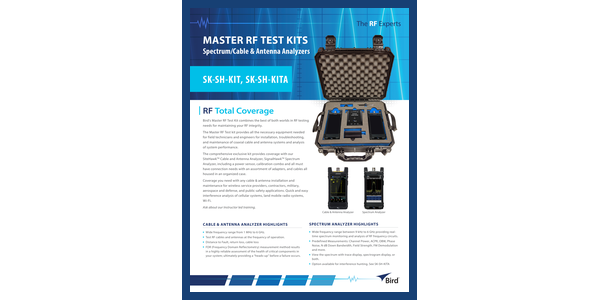
Add sensors, cables, or a pre-built kit to get testing fast.
Have more questions? Get Expert Help>
An antenna analyzer is used to measure and optimize antenna performance by checking parameters like VSWR, return loss, impedance, and resonance. It helps technicians quickly identify issues such as poor matching, damaged feedlines, or incorrect antenna tuning.
Antenna analyzers are widely used in RF communications, broadcasting, public safety, and amateur radio applications. For example, an antenna analyzer may measure a VSWR of 1.2:1 at 450 MHz and show an impedance close to 50 ohms, indicating a well-matched antenna system.
An antenna analyzer is designed primarily for field testing and tuning antennas, focusing on measurements such as VSWR, impedance, and return loss.
A Vector Network Analyzer (VNA) is more advanced and measures both magnitude and phase characteristics of RF networks, allowing detailed analysis of filters, amplifiers, cables, and antennas. VNAs are commonly used in laboratories and engineering environments, while antenna analyzers are optimized for faster, simpler field diagnostics.
For example, a VNA may measure S11 performance from 10 MHz to 6 GHz with accuracy down to fractions of a decibel.
Testing antenna performance typically involves measuring VSWR, return loss, impedance, and signal strength across the antenna’s operating frequency range.
Technicians use antenna analyzers, wattmeters, or VNAs to verify that the antenna is properly matched and radiating efficiently.
Field testing may also include coverage measurements and checking for cable or connector losses. For example, an antenna tuned for 900 MHz may be considered acceptable if the VSWR remains below 1.5:1 across a 20 MHz bandwidth.
Fundamentally, the Sitehawk performs 3 different types of measurements: cable loss, impedance v. frequency, and Distance to Fault via Frequency Domain Reflectometry (FDR). Where applicable, results can be returned in VSWR or Return Loss.
Your SiteHawk comes with an Open-Short-Load Calibration Combo. The SiteHawk needs a measurement calibration (also known as a field calibration) with the Combo when changing frequency ranges. Your SiteHawk should get a factory calibration at least once every 3 years.
Request a Factory Calibration Quote >
This depends on a few factors: the propagation velocity of your cable, the loss of your cable, and the frequency span of your measurement. Unless your cable lengths are >1 km, you shouldn't even need to worry about this.
If you do need to worry about this, contact our team of experts for help calculating your max distance.
With Bird, you get intuitive tools, industry-specific kits, and expert support—so you can solve problems faster and never feel stuck in the field.