
for CW, FM, and Digitally Modulated Signals

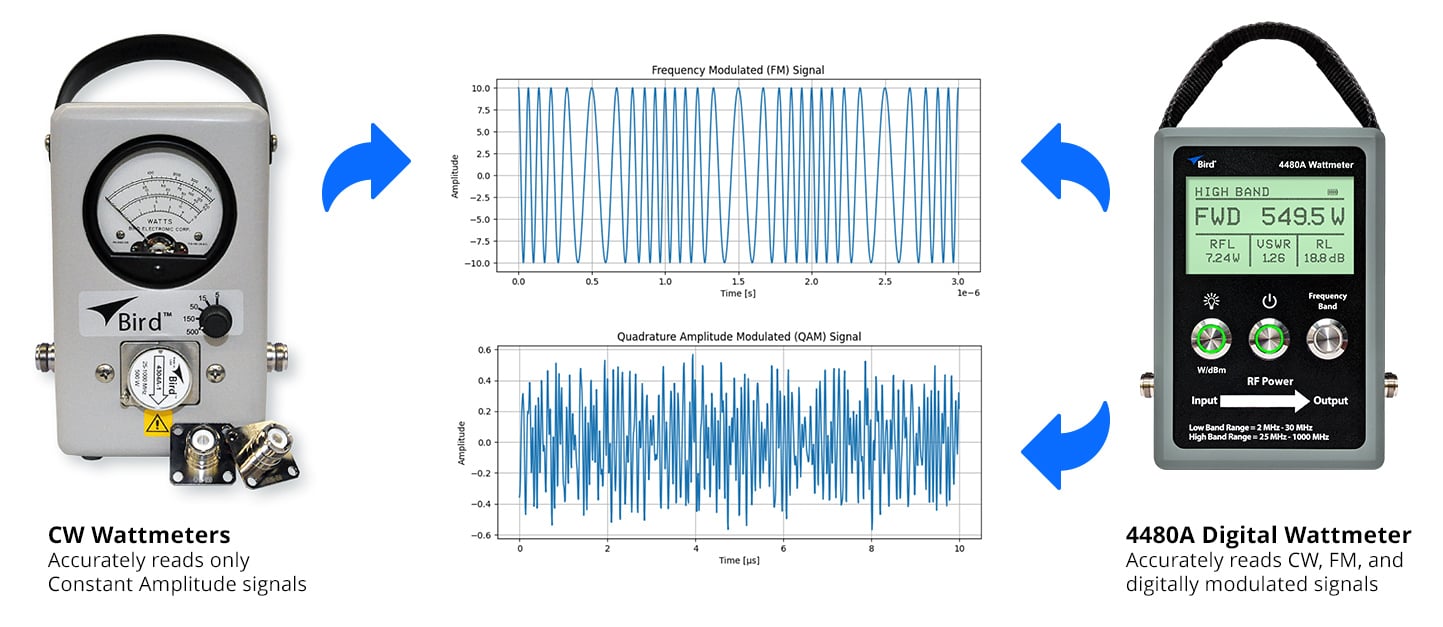
RF communications have evolved beyond simple CW and FM signals. Modern systems rely on digital modulation formats like QAM and DQPSK to deliver higher data rates, improved spectral efficiency, and enhanced performance in challenging environments. Many traditional wattmeters, particularly those designed for steady or analog waveforms, struggle to accurately measure the average power of digitally modulated signals due to their rapidly varying amplitudes and high peak-to-average ratios.

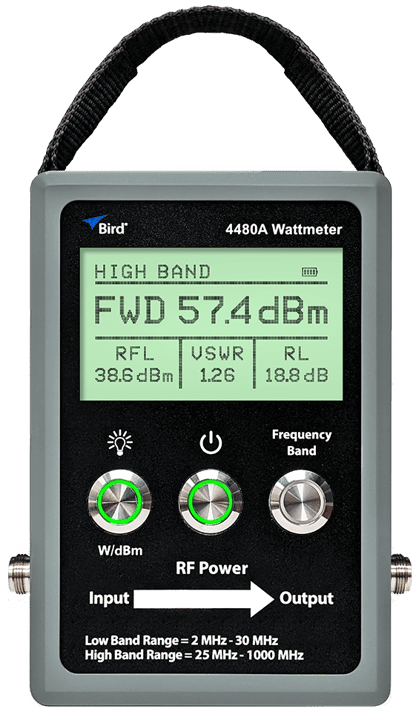
The Bird 4480A Digital Wattmeter delivers accurate average power measurements across a wide range of modulation types — from continuous wave to complex digitally modulated signals — while remaining simple to use for everyday RF measurements.

Measure RF signals from 2 MHz to 1 GHz at power levels up to 10,000 W without managing separate elements.
Eliminate inventory management hassles
Avoid errors from incorrect element selection
Stop tracking calibration dates across multiple elements
Save time—no field installations or element changes

Both forward and reflected power are measured correctly and simultaneously — every time.
No element orientation confusion
No bidirectional installation mistakes
The digital display is visible in any lighting condition and:
Eliminates scale reading guesswork
Removes inter-operator reading variability
VSWR and return loss are calculated and displayed automatically.
No manual calculations or chart lookups
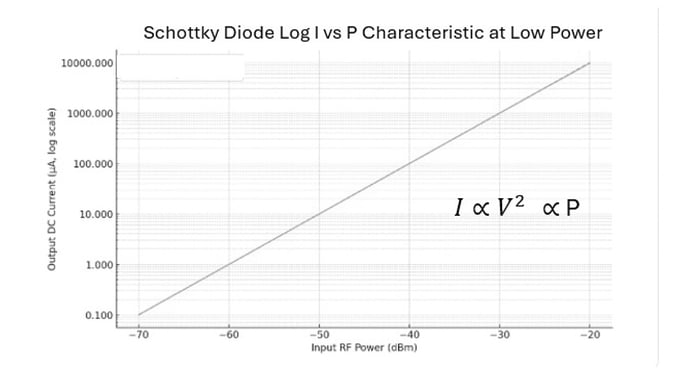
The 4480A employs Schottky diode technology operating in the square-law region, where output current is directly proportional to V² (power). This enables true average power measurement regardless of signal envelope or modulation format. See the white paper, Accurate, Error-Free RF Power Measurements in the Digital Era.
The 4480A’s performance has been validated through comprehensive testing against thermal power standards—the reference method traceable to NIST. Testing confirms ±4% accuracy for average power measurements across CW, FM, ASK, and QAM modulation formats. See the technical paper, A Comparative Study of RF Power Meters for Digitally Modulated Signals in Military Applications.

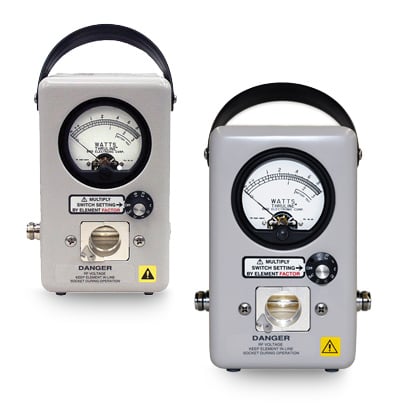
Operate their diode detector in its linear region, allowing accurate average power measurements of only constant-amplitude CW and FM signals
Overestimate or underestimate average power in amplitude-varying signals
8-10 hours on internal rechargeable battery or continuous operation from 12V DC external power.
One button press: HIGH band (25 MHz-1 GHz) or LOW band (2-30 MHz).
Switch between watts and dBm instantly to match your application.
That's it. Take your measurements with confidence.
Accurate RF power measurement is essential for maintaining system performance, ensuring regulatory compliance, and protecting critical equipment.
Ensure transmitters operate at specified power levels to reach all intended service areas and maintain reliable communications at design distances
Avoid fines, license restrictions, or interference complaints by staying within maximum legal values
Prevent excessive power output that causes interference with other systems
Identify impedance mismatches through accurate VSWR measurements before reflected power damages transmitter output stages
Verify that RF energy is radiated effectively rather than wasted in transmission line losses
Establish performance baselines and detect degradation trends before system failures occur
Ensure reliable communication at coverage area boundaries for police, fire, EMS, and emergency management agencies.
Maintain accurate power levels for tactical and strategic RF systems. Ensure transmission power isn't too high for enemy detection or too low to prevent critical communication.
Meet government-certified communication equipment requirements (such as FAA certification for airplanes, Coast Guard compliance for vessels).
Confirm accurate transmitter power levels to support reliable RF communications used for control, monitoring, and telemetry in utility and industrial systems.
Schottky diode–based measurement architecture delivers accurate average power readings independent of modulation format
Dual bands span HF, VHF, and UHF allocations
Measure power levels from 1 watt to 10 kilowatts
Forward power, reflected power, VSWR, and return loss displayed concurrently
Display power in watts or dBm
No elements to select, install, or manage
No element rotation required
No charts or manual calculations
Three-button control—minimal training required
Type N QC connectors enable rapid installation
Internal battery for field use
Allows software updates through rear-panel USB Type-B port
MIL-PRF-28800 Class 3 certified for environmental and performance compliance. Built on Bird's 80+ years of experience delivering field-proven RF measurement equipment.
Upgrade to the 4480A Digital Wattmeter to accurately measure average RF power on the digital modulation transmissions of your advanced communication systems and make the job easier for your technicians.

Have more questions? Get Expert Help

Traditional wattmeters are designed for constant amplitude RF signals like CW and FM, using diode detectors operated in their linear region to measure signal peaks and compute average power. Digitally modulated signals have time-varying amplitudes that linear-region diode detectors and traditional wattmeter electronics cannot accurately measure. The Bird 4480A overcomes this limitation by using a Schottky diode operated in its square law region, where output is directly proportional to power (V²), enabling accurate true average power measurements for both constant amplitude and variable amplitude digitally modulated signals.
The Bird 4480A uses a Schottky diode detector operated in its square-law region, where detector output is proportional to RF power rather than voltage peaks. This square-law operation enables accurate true average power measurements on time-varying, digitally modulated signals with peak-to-average ratios up to 10 dB.
Unlike traditional wattmeters, the 4480A does not rely on external, frequency- and power-specific elements, which can introduce additional uncertainty. The result is consistent ±4% accuracy for average power measurements across CW and digitally modulated signals throughout its 2 MHz to 1000 MHz frequency range.
Element-free design eliminates the need to carry, swap, and manage multiple frequency-specific and power-specific elements, reducing measurement errors caused by wrong element selection or damaged elements. The Bird 4480A covers 2 MHz to 1000 MHz in two bands without any elements, streamlining field operations and eliminating element-related errors. This results in faster measurements, reduced downtime, and consistent accuracy for improved reliability.
The Bird 4480A Digital Wattmeter uses directional coupling technology with approximately 30 dB of directivity to independently sample forward and reflected RF power flowing through the transmission line. Internal circuitry converts these RF signals into digital values for processing and display.
The LCD simultaneously displays forward power, reflected power, VSWR, and return loss in real time, providing immediate insight into transmission line performance. This allows technicians to quickly identify impedance mismatches and evaluate system performance without requiring additional measurements or reconfiguration.