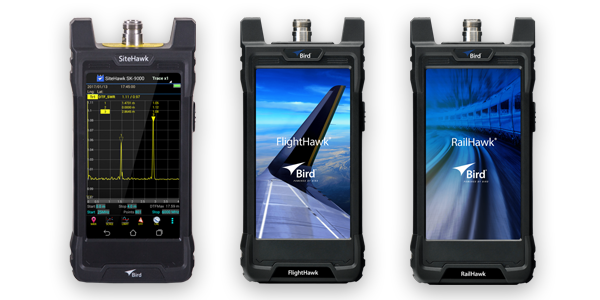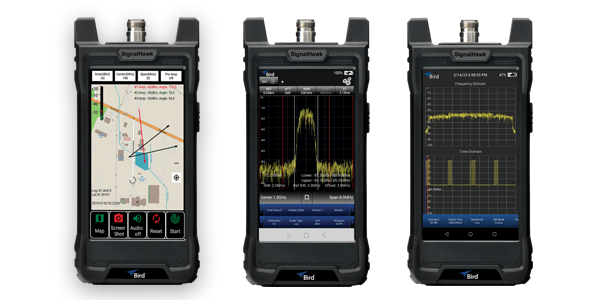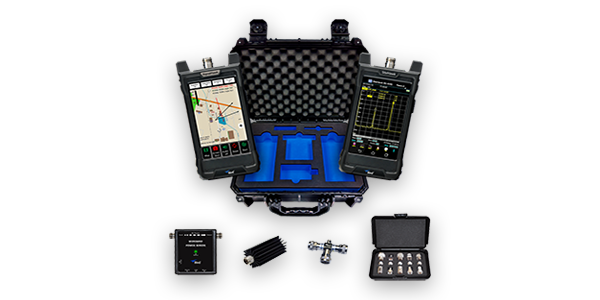
From quick scans to deep dives, Bird’s RF analysis tools give you the insights you need to get the job done whether you're on the bench, in the field, or on the manufacturing floor.
A network analyzer in RF is an instrument used to measure how signals behave as they pass through components such as cables, filters, antennas and amplifiers.
It measures S-parameters (scattering parameters), including S11 (input reflection), S21 (forward transmission), S12 (reverse transmission), S22 (output reflection), typically across a frequency range such as 1 MHz to 6+ GHz. Results are expressed as gain/loss (dB), impedance (Ω) and return loss (dB). This helps engineers characterize and optimize RF system performance.
The best network analyzer depends on the application, frequency range, and required accuracy, with options ranging from handheld units to high-performance lab instruments.
For example, a field technician may use a portable analyzer covering 100 kHz to 4 GHz, while a lab-grade system might operate up to 40 GHz with measurement accuracy within ±0.05 dB.
Key factors include dynamic range, calibration capabilities, and connector compatibility (e.g., N-type or SMA). Selecting the right analyzer ensures reliable measurements for tasks like antenna tuning or filter design.
If you’re not sure what tool you need, ask our RF experts how you can be saving time, money and effort in your RF tasks.
Explore our Learning Center for resources tailored to all experience levels—from those new to the RF industry to seasoned professionals.